Women in Construction: The 2026 Trends You Need to Be Ready For (and Why They Matter)
January 26, 2026
.
Construction doesn’t drift into the future. It gets dragged there, usually by a labor shortage, a new compliance requirement, and one project manager who finally snaps and says, “There has to be a better way.”
2026 is shaping up to be exactly that kind of year.
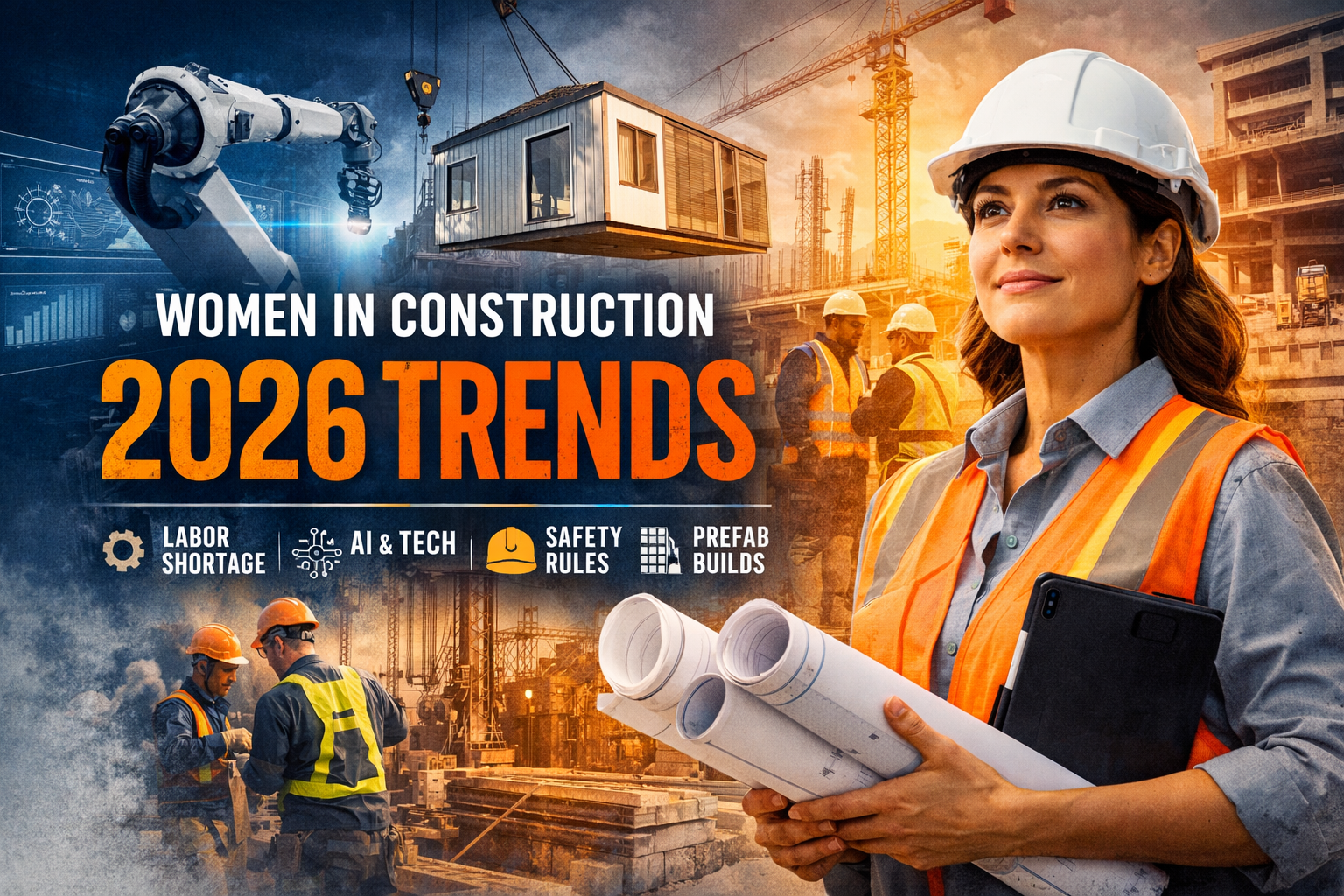
If you’re a woman in construction (or you lead teams that want to attract, keep, and promote women), the trends ahead aren’t abstract. They affect who shows up to work, how work gets done, what gets built, and which companies win the next round of market share.
Let’s break down what’s coming and what it really means.
1) The talent shortage stops being “a problem” and becomes “the strategy”
The industry has been talking about labor constraints for years. In 2026, the numbers get louder. Deloitte’s 2026 engineering and construction outlook points to the need for roughly 499,000 new workers in 2026, up from 2025, and frames it as a structural issue that drives delays, cost overruns, and margin pressure. Deloitte
Meanwhile, contractors are not just worried about hiring, they’re already living it. AGC reporting shows widespread difficulty filling roles, with firms increasingly pointing to technology (including AI/robotics) as a pressure-release valve for labor and productivity. Associated General Contractors+1
Implication for women in construction:
This is the moment when “women as a workforce solution” stops being a DEI tagline and becomes an operational necessity.
The Fixr 2025 Women in Construction report cites 1,343,000 women in construction (11.2% of the workforce) and continued year-over-year growth. assets.fixr.com The direction is positive, but 11.2% is still a tiny slice of a huge industry that needs bodies, brains, and leadership capacity now.
What to do before 2026 hits full speed:
-
Treat recruiting women like you treat bid opportunities: track the funnel, remove friction, improve conversion.
-
Fix jobsite basics that disproportionately push women out (PPE sizing, restroom access, scheduling predictability). These aren’t perks. They’re retention infrastructure.
-
Make advancement visible and real. NCCER’s research on women’s experiences in construction digs into barriers like culture, mentorship, and career progression, and those themes are exactly where firms leak talent. NCCER
2) AI and automation move from “interesting” to “non-negotiable”
In 2025, many firms were still experimenting with AI. In 2026, the firms that operationalize it will separate from the ones that merely talked about it at conferences.
AGC survey findings show a meaningful share of contractors believe AI and robotics will improve jobs by automating manual, error-prone tasks and improving safety and productivity. Associated General Contractors Deloitte similarly frames digital and workforce innovation as the way through persistent shortages. Deloitte PCL’s 2026 outlook goes further: to meet demand at the expected pace and quality, AI adoption needs to accelerate. PCL Construction
Implication for women in construction:
AI is a rare lever that can reduce dependence on brute-force labor and increase the value of planning, coordination, quality management, procurement strategy, and field leadership.
That matters because women are still underrepresented in craft roles, but increasingly present in management pathways. If your company uses AI to upgrade project execution (scheduling, risk forecasting, submittal workflows, safety analytics), you create more seats at the table where women are already gaining ground and can accelerate into senior roles.
How to prepare:
-
Pick 2–3 workflows where AI can measurably reduce cycle time: RFIs, submittals, daily reports, safety observations, procurement tracking.
-
Train superintendents and PMs on “AI as a co-pilot,” not “AI as a replacement.” Adoption is behavior change.
-
Build guardrails: data hygiene, version control, and clear accountability for final decisions.
3) Data centers stay hot (even if growth cools), and they reshape local labor markets
Data centers have been the rocket fuel in nonresidential work, and the momentum carries into 2026. ENR’s reporting highlights forecasts that keep data center construction growing in 2026, even as the market debates whether the surge is nearing a peak growth rate. Engineering News-Record Other industry reporting also frames data centers and energy infrastructure as standout sectors heading into 2026. Deloitte+1
Implication for women in construction:
Data center projects are process-heavy, documentation-heavy, schedule-intense, and quality-critical. That rewards disciplined project controls, strong coordination, and leadership that can run a tight ship under pressure.
It also means competition for talent gets more vicious in the markets where data center pipelines concentrate. Even if your company doesn’t build data centers, you’ll feel the suction effect on electricians, HVAC, concrete, steel, and experienced supers.
Preparation moves that actually help:
-
Lock in trade partnerships earlier and treat preferred subs like strategic assets, not interchangeable line items.
-
Invest in foreman development and field leadership training. Your biggest risk isn’t shortage of labor, it’s shortage of leaders.
-
For women specifically: create fast-track pathways into high-demand roles (quality manager, safety lead, assistant super, scheduler) that data-center-style delivery rewards.
4) Infrastructure funding uncertainty becomes a planning problem, not a policy debate
Yes, infrastructure work is still strong, and yes, there’s money in motion. But multiple outlooks point to timing risk as authorizations under the Infrastructure Investment and Jobs Act approach expiration in 2026, which can create uncertainty in bid timing and project packaging. Nationwide Newsroom+1
Implication for women in construction:
Uncertainty punishes companies that don’t plan scenario-by-scenario. It rewards companies with financial discipline, diversified backlogs, and leaders who can pivot.
This is where women in leadership can shine, because the next phase isn’t just “build.” It’s “decide smartly what to chase, what to price, and what to walk away from.”
What to do now:
-
Build a 2026 pipeline model with three cases: optimistic, base, defensive.
-
Pressure test staffing under each scenario. Don’t get caught over-hired or under-resourced.
-
Cross-train PMs and supers across project types so you can redeploy quickly.
5) Heat safety and jobsite conditions get stricter (and they should)
OSHA’s heat rulemaking has been active, including public hearings in 2025 on Heat Injury and Illness Prevention in Outdoor and Indoor Work Settings. OSHA Industry groups are already pushing for clarity and construction-specific considerations. National Association of Home Builders
Whether the final standard lands exactly as proposed or evolves, the direction is clear: formal heat planning, training, acclimatization, and documented controls are becoming table stakes.
Implication for women in construction:
This is a safety shift that improves conditions for everyone, but it also intersects with retention. People don’t leave construction because they “don’t like hard work.” They leave because the industry sometimes confuses unnecessary suffering with toughness.
Also: women frequently report jobsite conditions and culture as key friction points. NCCER’s research on women’s experiences puts workplace culture and advancement barriers squarely on the table. NCCER Stronger safety systems and more professional site standards can be a culture upgrade, not just compliance.
Prep checklist:
-
Build a heat plan now: triggers, hydration, shade, rest, acclimatization, emergency response.
-
Train supervisors to enforce it consistently (inconsistent enforcement is where safety programs go to die).
-
Treat safety as brand. The best people choose employers that look like they’ll still have their knees at age 55.
6) Offsite, prefab, and modular keep creeping into “normal”
Prefab isn’t new. What’s new is that labor scarcity and schedule compression keep making it look smarter. Market reporting and industry chatter continue to point to modular/prefab growth as a pragmatic response to labor and speed constraints. Business Wire+1
Implication for women in construction:
Offsite work can reduce some physical barriers, offer more stable hours, and create manufacturing-style pathways where women have historically found stronger footing. It also shifts influence toward planning, logistics, quality systems, and coordination.
If your company ignores prefab because “we’ve always stick-built,” congratulations. You’ve volunteered to compete on the hardest playing field with the fewest players.
Preparation:
-
Pilot prefab on one scope: bathrooms, MEP racks, wall panels, truss packages.
-
Build procurement and design coordination muscle. Prefab punishes late decisions.
-
Promote leaders who can coordinate across design, factory, and field. That skill set is gold in 2026.
What this really means for 2026
2026 will reward construction companies that treat workforce, technology, and safety as one integrated system, not three separate initiatives led by three separate committees that never meet.
And for women in construction, it’s a leverage year.
-
The labor shortage creates urgency to recruit and retain women. Deloitte+1
-
The growth in women’s participation shows momentum, but also highlights how much upside remains. assets.fixr.com
-
The tech shift increases the value of leadership, coordination, and systems thinking, where women can accelerate into influence. Associated General Contractors+1
-
The safety and professionalism push gives the industry a chance to drop the outdated belief that misery equals competence. OSHA+1
If you’re building your 2026 plan, don’t just ask, “What projects will we win?” Ask, “What kind of company will people choose to work for when everyone is hiring?”
Because in 2026, the best crew you’ll ever build might be the one that doesn’t quit.
About Draper DNA
Draper DNA is a boutique marketing agency built for building-products manufacturers, construction brands, and the people shaping the built environment. We specialize in turning complex categories into clear stories that drive demand, preference, and growth across the entire Spec-to-Site journey—from architects and engineers to builders, dealers, and homeowners.
We don’t chase trends for sport. We study how materials, labor realities, sustainability pressures, technology shifts, and lifestyle expectations collide in the real world—and then we translate that into marketing that actually works. Our proprietary frameworks, including the DNA Channel Map™, Spec-to-Site Framework™, and Materiality Marketing™, help brands align product truth, market timing, and customer behavior so what gets specified actually gets installed.
Draper DNA partners with companies that build things meant to last. The kind that understand performance, people, and purpose aren’t separate conversations—they’re the same one. If you’re navigating workforce shifts, new technologies, or changing expectations in construction and building products, we help you tell that story with clarity, credibility, and conviction.
In short: we help serious brands show up like they mean it.