
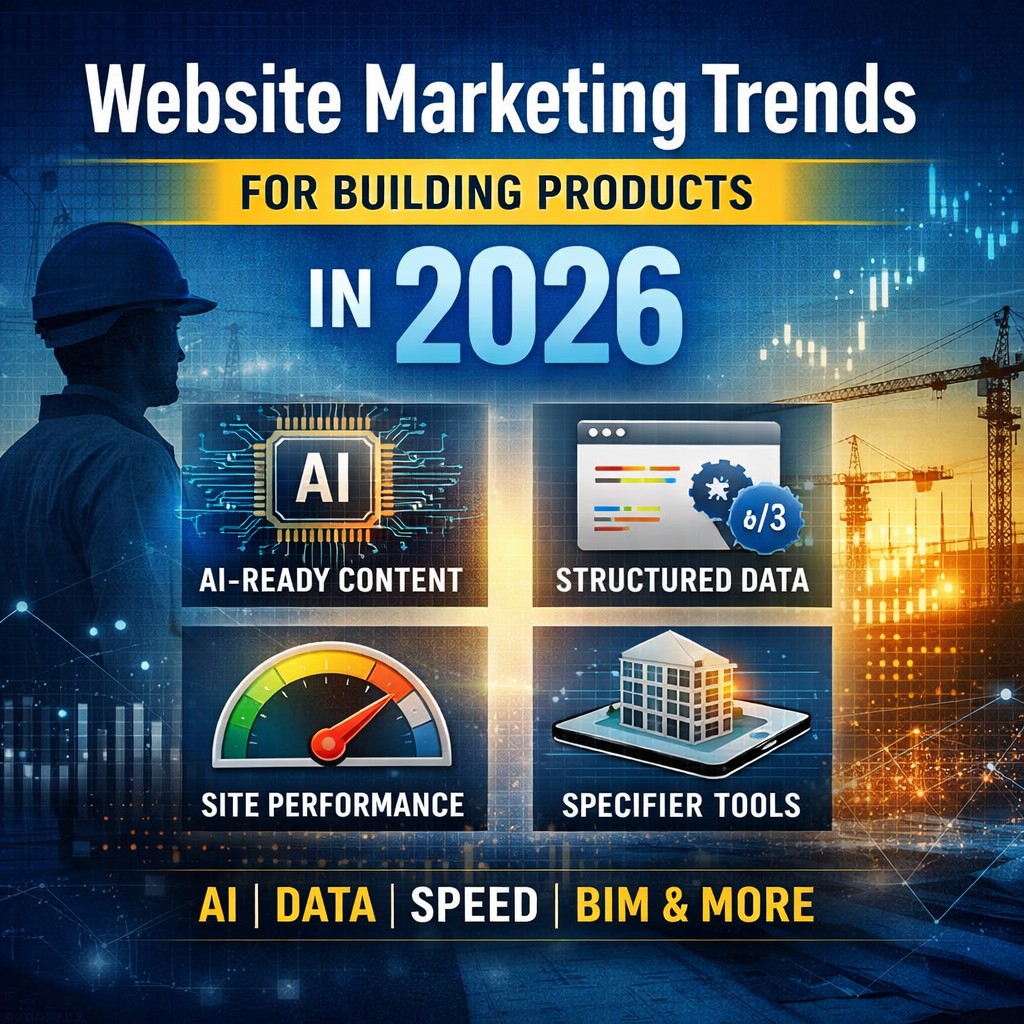
Website marketing trends to prepare for in 2026 (and what they mean for building products manufacturers)
February 1, 2026
.
Your website used to be the place where people came to learn. In 2026, it’s increasingly the place where people come to verify.
Architects, builders, contractors, designers, and remodelers are still visiting manufacturer sites. But the path that gets them there has changed: more answers are happening before the click, more filtering happens in-spec software and marketplaces, and expectations for speed, accessibility, and “don’t-make-me-work-for-it” content are higher than ever.
If your website still acts like a digital brochure, you’re not just behind. You’re invisible at the exact moment your customer is trying to decide.
Let’s break down the trends that matter in 2026 and exactly how to apply them to the building products world.
1) Zero-click visibility is the new front door
Search is increasingly delivering answers directly in the results, which means fewer clicks to websites—even when you’re “winning.” Bain summarized this shift bluntly: consumers are using zero-click results frequently, and brands are seeing measurable organic traffic decline as a result.
What this really means for building products manufacturers:
You need to design content to show up well without the click and still reward the click when it happens.
Do this on your site:
-
Build “answer blocks” on key pages (product categories, assemblies, FAQs): crisp definitions, use cases, install constraints, warranty highlights, lead times, and what it replaces.
-
Write spec-friendly summaries: “When to use X vs Y” and “Top 5 reasons this fails in the field.”
-
Treat every product page like a mini knowledge base, not a SKU page.
Do this for each audience:
-
Architects: performance claims + standards + compliance + BIM/CSI mapping.
-
Builders/contractors: install steps, tolerances, sequencing, and troubleshooting.
-
Designers: finish options, visualizers, photography, and “pairing” guidance.
-
Remodelers: retrofit constraints, lead time clarity, and how to avoid call-backs.
2) Generative AI is reading your site like a machine (because it is)
Whether your buyer uses Google, Bing, ChatGPT-style tools, or AEC-specific search experiences, the underlying truth is the same: machines are summarizing the web. If your product information is incomplete, inconsistent, or buried in PDFs, you’re training the internet to misunderstand you.
Your edge in 2026 isn’t more content. It’s cleaner product truth.
Do this on your site:
-
Create a single source of truth per product family: performance, testing standards, configurations, compatible accessories, installation constraints, warranty, maintenance.
-
Publish structured, scannable content blocks (tables, bullets, specs) instead of prose-only pages.
-
Maintain “canonical” pages for each product/solution so search and AI systems don’t have to guess.
3) Structured data stops being optional
Google is very clear that structured data helps product information appear in richer ways in search results (price, availability, ratings, etc.). And even when you’re not selling direct-to-consumer, structured data still matters because it clarifies what a product is.
What this means for building products manufacturers:
You’re not marking up “ecommerce.” You’re marking up credibility and clarity.
Do this on your site:
-
Use Product structured data appropriately where it applies (and avoid spammy markup).
-
Add Organization, Breadcrumb, FAQ (where allowed/appropriate), and HowTo-style content when it genuinely helps.
-
Treat product taxonomy like an information architecture project, not a navigation project.
4) Site performance is now a revenue lever, not a dev nice-to-have
Google replaced First Input Delay (FID) with Interaction to Next Paint (INP) as a Core Web Vital in March 2024, shifting the emphasis toward real interaction responsiveness.
What this means in the field:
If your product pages are slow, your buyer doesn’t “wait.” They bounce… and then spec something else.
Do this on your site:
-
Audit and reduce script bloat (especially tag stacks that piled up over years).
-
Make spec docs and install guides fast to open and searchable (HTML first; PDFs as secondary).
-
Optimize images like you mean it: modern formats, correct sizing, and lazy loading.
5) Accessibility is moving from “should” to “must”
WCAG 2.2 is now a W3C Recommendation (with publication and updates documented by W3C). Even if you’re not thinking about compliance, your customers are thinking about usability: keyboard navigation, readable contrast, form clarity, and mobile behavior.
What this means for building products manufacturers:
Accessibility upgrades aren’t just risk reduction. They improve conversion rates because they reduce friction for everyone.
Do this on your site:
-
Fix forms: labels, error states, tab order, focus indicators.
-
Make spec tables readable and navigable.
-
Ensure color contrast works (your brand team will survive, I promise).
6) Privacy and consent aren’t just legal—they’re measurement reality
If you market in or receive traffic from Europe, Google requires passing consent signals for measurement with Google tags, and it has updated consent mode parameters to support more granular consent collection.
At the same time, the third-party cookie story continues to evolve. Google has stepped back from a full phase-out approach in Chrome and is keeping user choice in focus, according to reporting by Reuters.
Translation: measurement will keep getting messier, and “we’ll just retarget them” is not a strategy.
Do this on your site:
-
Invest in first-party conversions: spec downloads, sample requests, dealer locators, “talk to a rep,” project calculators.
-
Clean up analytics: define events that map to real buying stages (not vanity pageviews).
-
Make your CRM and marketing automation integration boring, stable, and accurate. Boring is good here.
7) AEC buyers expect tools, not brochures
Your customer is doing math: budget, lead times, performance, compatibility, risk. If your website doesn’t help them compute reality, they will go somewhere that does.
Do this on your site:
-
Add configurators (even “simple” ones): system build-ups, accessories, finish selection.
-
Add calculators: coverage, fastener patterns, acoustic performance ranges, moisture management basics.
-
Add decision guides: “If you’re in climate zone X / wall assembly Y / occupancy Z, start here.”
8) BIM and spec content distribution is a website strategy now
AEC professionals don’t just “browse.” They pull content into workflows. BIM libraries and manufacturer content ecosystems are where many spec decisions start and where trust gets built.
BIMobject’s 2025 report positioning emphasizes where specifiers search and what content earns trust—insights explicitly framed to inform planning for 2026 and beyond.
What this means:
Your website must act as the hub that powers your BIM/spec presence elsewhere.
Do this on your site:
-
Create a Specifier Hub: BIM objects, specs, details, certifications, EPDs/HPDs, master specs, and “how to specify” guides.
-
Track what gets downloaded and tie it to account-based marketing lists (ethically, with consent where required).
-
Make every external BIM listing point back to a canonical, structured product page on your site.
9) Your website has to sell the relationship, not just the product
Building products aren’t impulse buys. They’re risk decisions. Your website should reduce perceived risk at every step.
Do this on your site:
-
Publish installation systems that show how you prevent failure (details, sequencing, compatibility).
-
Add “proof packs” by audience:
-
Architect pack: test data, compliance, details, BIM, warranty language.
-
Builder pack: install guides, field videos, sequencing, labor-saving notes.
-
Contractor pack: common mistakes, troubleshooting, ordering clarity.
-
Designer pack: visuals, finish storytelling, pairing guides.
-
Remodeler pack: retrofit FAQs, lead times, “what will go wrong if…” guidance.
-
10) The new conversion isn’t “contact us.” It’s “make it easy for me to keep going.”
In 2026, the best manufacturer sites behave like an assistant:
-
they answer the question,
-
anticipate the next question,
-
and remove the next obstacle.
Practical site CTAs that work in building products:
-
Download spec + details (gated lightly, if at all)
-
Request a sample
-
Find a dealer / rep
-
Build a system and export a submittal
-
Compare products
-
Get an install checklist
-
Start a warranty registration flow
If your primary CTA is still “Contact,” you’re asking busy pros to do your job for you. Bold strategy. Rarely rewarded.
A 2026-ready website checklist for building products manufacturers
If you want a simple gut check, your website should be able to answer—fast and clearly:
-
What is this product, and where does it belong in an assembly?
-
Why should I trust it (testing, code, warranty, proof)?
-
How do I install it without surprises?
-
What do I download to specify it?
-
Who sells it near me (or who supports my project)?
-
What’s the next step for my role (architect vs builder vs remodeler)?
If any of those answers are hard to find, you’re paying to acquire demand you can’t convert.
Draper DNA is a marketing consultancy built for the building products and construction ecosystem. We help manufacturers align brand, channel strategy, and demand generation with how architects, builders, contractors, designers, and remodelers actually buy—and specify—products.
If your website isn’t pulling its weight in 2026, Draper DNA can help you fix it end-to-end: customer and channel insight, content strategy, information architecture, SEO and structured data, conversion paths, performance and accessibility priorities, and a practical rollout plan your team can execute. We can also partner with your internal team and developers (or bring the right build resources) to design and implement a custom website that’s faster, clearer, and built to convert real project demand.
If you’re ready to turn your website into a spec-and-sales engine, reach out to Draper DNA and let’s map what your customers need next—and how your site should deliver it.