Trade Shows & Events in 2026: The New Rules for Building-Products Brands (and the People Who Specify, Buy, and Install)
February 1, 2026
.
If your 2026 trade show plan is basically “same booth, same swag, same tired lead form,” congratulations: you’re about to spend a lot of money proving you can still show up. The events world is growing again, but expectations have moved on.
For building-products manufacturers, that matters more than most industries. Your audience is hands-on, time-starved, skeptical, and allergic to fluff: architects want proof, builders want predictability, contractors want speed and fewer callbacks, designers want confidence and story, remodelers want solutions that work in the real world. Events can absolutely deliver all of that, but only if you treat them like a system, not a calendar entry.
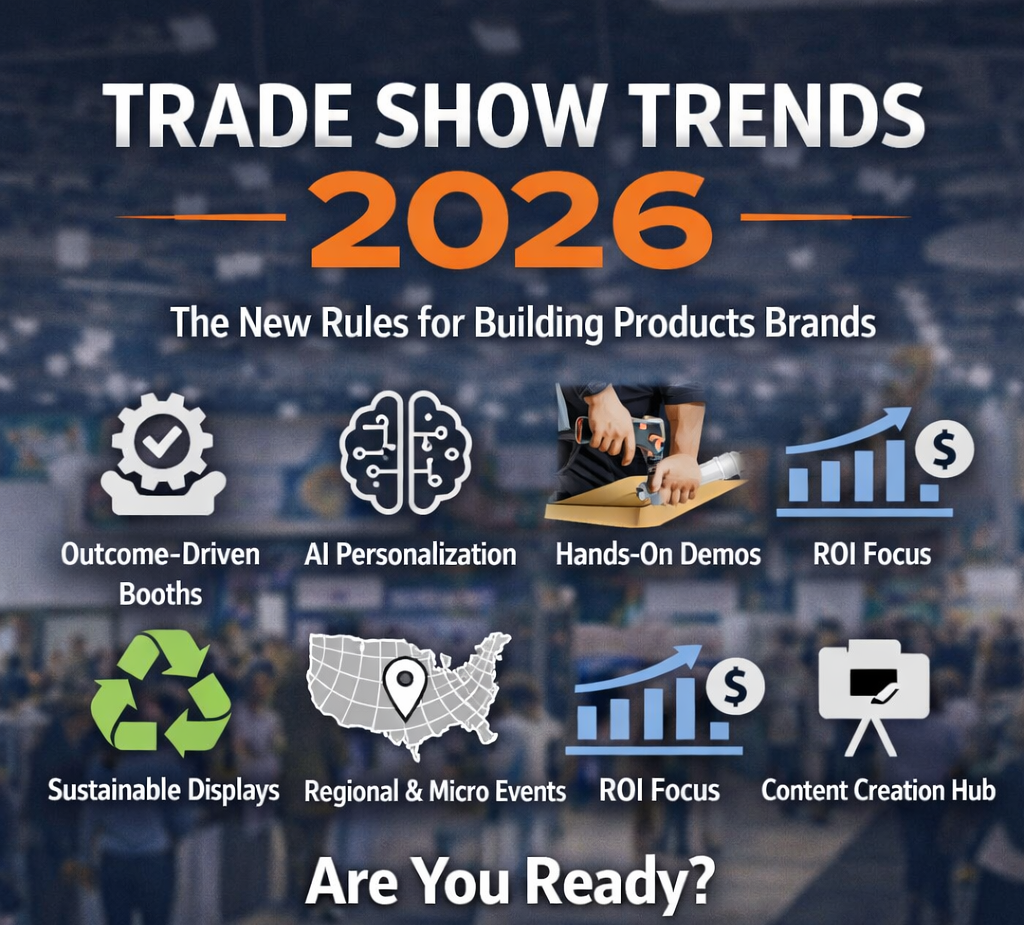
Here are the trends that will define trade shows and events in 2026, and how to apply them to the architect-builder-contractor-designer-remodeler ecosystem.
Trend 1: Outcomes beat “wow” every time
Attendees aren’t chasing spectacle. They’re chasing progress: better decisions, better contacts, better answers. Freeman’s research highlights that a standout “peak moment” boosts return intent, but the definition of “great experience” is tied to personal outcomes, not theatrics.
What this means for building-products brands
Stop designing booths like billboards. Design them like decision accelerators.
-
Architects/specifiers: Make it easy to specify. Provide assemblies, details, code references, EPD/HPD links, BIM objects, and a QR path to a spec package that doesn’t require a scavenger hunt.
-
Builders/GCs: Show risk reduction: lead times, install time, change-order prevention, warranty clarity, labor savings.
-
Contractors/installers: Demonstrate “fewer mistakes, faster installs.” Let them touch it, cut it, fasten it, seal it, and break it.
-
Designers/remodelers: Make selection simpler: curated palettes, finish boards, performance story in plain English, and clear compatibility with adjacent materials.
Pro tip: Build your booth around 3 outcomes max. If it takes longer than 10 seconds to understand what problem you solve, you’ve built a museum.
Trend 2: ROI is under pressure, and “return on attendance” is the real fight
Costs are still a headwind. Travel costs and inflation have impacted attendance and exhibit sales, and the industry is openly talking about an ROI crunch.
What this means for building-products brands
Your event plan needs a measurement spine that connects:
Pre-show demand → On-site engagement → Post-show follow-through → Revenue impact
Practical moves:
-
ABM your show list. Don’t just “go to IBS.” Go after accounts and projects.
-
Define lead tiers. Specifier-influencer leads are different from contractor-ready-to-buy leads.
-
Build follow-up paths by persona. Architects get spec support and CEU content; contractors get install guides and distributor availability; builders get ROI calculators and project support.
If you can’t explain what success looks like before the show, the post-show report will be a work of fiction.
Trend 3: AI-powered personalization is getting real (and expected)
AI is moving from “event buzzword” to practical tooling: matchmaking, personalization, content recommendations, faster planning, smarter follow-up. Multiple 2025–2026 trend reports point to AI-driven personalization as a defining direction for MICE and B2B events.
What this means for building-products brands
Use AI to make your team faster and your attendee experience tighter, without becoming creepy.
-
Pre-show: build lists, write persona-specific invites, tailor meeting offers by segment (specifier vs installer).
-
On-site: dynamic demos (pick your pain point: moisture, acoustics, fire, speed, labor shortage).
-
Post-show: summarize conversations, generate next steps, route leads intelligently, and personalize follow-up content.
The bar in 2026 is “you remembered what I care about,” not “you spammed me with the same PDF everyone gets.”
Trend 4: Hands-on education is winning
Interactive, practical learning is increasingly preferred, especially as newer generations shape expectations. Freeman reporting highlights strong preference for interactive formats for education and technical information.
What this means for building-products brands
Your best “session” may not be a session. It may be a 7-minute micro-demo repeated all day.
Ideas that work:
-
Jobsite theatre: live install, teardown, common failure modes, troubleshooting.
-
Spec lab: side-by-side comparisons of assemblies, performance tradeoffs, detailing pitfalls.
-
Remodel reality corner: show how the product behaves in imperfect conditions (because remodels are basically “surprises, but with invoices”).
If you sell anything that gets installed, a hands-on moment is worth ten brochures.
Trend 5: Sustainability isn’t a slide anymore. It’s a filter.
Sustainability and climate concerns remain a material issue for the exhibition industry, and exhibitors are leaning into modular, reusable, lower-waste approaches.
What this means for building-products brands
You don’t get credit for saying “sustainable.” You get credit for proving it and making it easy to specify.
Event execution moves:
-
Modular booth systems you reuse across 4–6 shows.
-
Material transparency front and center: EPDs, carbon story, sourcing, durability, end-of-life.
-
Less landfill marketing: fewer cheap giveaways, more useful tools (spec kits, install checklists, field guides).
Also: sustainability is now tied to procurement and project requirements. If your event story doesn’t connect to how projects are awarded, it’s just vibes.
Trend 6: Smaller, regional, and customer-hosted events will keep gaining share
Large shows are still important, but brands are balancing them with more targeted formats: regional roadshows, distributor open houses, lunch-and-learns, builder summits, and design community events. This is partly economics, partly effectiveness, partly the need for tighter targeting under ROI pressure.
What this means for building-products brands
Build a portfolio, not a monolith:
-
Tier 1: flagship industry shows (brand + pipeline)
-
Tier 2: regional shows aligned to territory goals (distribution + conversion)
-
Tier 3: owned events with partners (specification + loyalty)
Owned events are where you can control the agenda, the guest list, and the follow-up. And magically, the leads tend to be better. Funny how that works.
Trend 7: Your booth is now a media studio
The best exhibitors are treating events as content engines: short-form demos, spec tips, “myth vs reality,” installer hacks, project spotlights, and partner interviews. This aligns with the broader push toward multi-touch engagement and measurable outcomes.
What this means for building-products brands
Plan content like you plan freight:
-
Pre-schedule interviews with architects, builders, and contractors.
-
Capture install demos in clean, repeatable formats.
-
Build a post-show content runway: 30 days of usable clips, not 300 random photos of your booth.
In 2026, “we went to a show” is not a strategy. “We turned a show into pipeline and content” is.
A practical 2026 playbook for building-products manufacturers
If you want a simple operating model for 2026:
-
Pick 3 audiences per event (not 8)
-
Define 3 outcomes you’ll deliver on-site
-
Build 3 demo paths (specifier, builder, installer)
-
Run 1 measurement system across all events
-
Create 1 follow-up engine with persona-specific tracks
Then repeat, refine, and scale.
Trade shows and events that actually move the needle
Draper DNA is a marketing consultancy and agency built to help building-products manufacturers win where it counts: with architects, builders, contractors, designers, and remodelers. We develop and implement custom trade show and events programs that connect brand strategy to real outcomes, from booth messaging and demo design to ABM targeting, partner activation, lead management, and post-show follow-through.
If you’re ready to turn your 2026 event calendar into a pipeline system (and stop paying for “nice booth” compliments), Draper DNA can help you:
-
Audit your current event portfolio and ROI
-
Build a right-sized 2026 event strategy by audience and channel
-
Design high-performing booth experiences and hands-on demo programs
-
Align sales, marketing, and distribution for cleaner follow-up and higher conversion
-
Create a content and measurement engine that compounds across every show
If you want help building a smarter, more profitable trade show and events program for 2026, reach out to Draper DNA and we’ll map the plan to your goals, your channels, and your customers.