Loyalty Marketing Trends to Prepare for in 2026
February 1, 2026
.
What building products manufacturers should do now to win architects, builders, contractors, designers, and remodelers
Loyalty is changing shape. In 2026, it’s less about dangling points like shiny objects and more about building productive habits with the people who specify, buy, install, and recommend your products.
That shift matters a lot in building products, where:
-
the buyer is often not the user
-
the decision is rarely impulsive
-
“loyalty” can mean anything from spec preference to installer confidence to dealer stocking behavior
-
and one bad jobsite experience can nuke a relationship faster than a wet OSB stack in a hurricane
Let’s break down the loyalty trends that will actually matter in 2026, and how manufacturers can apply them to the architect, builder, contractor, designer, and remodeler ecosystem.
1) Loyalty becomes value engineering, not vibes
Most loyalty programs still act like it’s 2012: buy stuff, get points, redeem for a blender no one asked for. In 2026, the winning programs will feel more like a value layer wrapped around the relationship.
Why? Because customers are value-seeking and less patient with programs that don’t pay off quickly or clearly. Deloitte’s recent loyalty survey work emphasizes this shift toward value-seeking behavior and loyalty program expectations.
What this means for building products
Your “loyalty” offer should reduce friction and risk for the trade. The best rewards in this category often aren’t trinkets. They’re things like:
-
Jobsite certainty: priority lead times, expedited replacements, emergency will-call access
-
Cost certainty: locked pricing windows, quarterly rebate tiers, predictable accrual
-
Performance certainty: on-demand technical support, field troubleshooting, install hotlines
-
Business certainty: co-marketing, lead sharing, preferred listing tools, referral engines
Concrete plays for 2026
-
Contractor loyalty tiers based on verified installs, not purchases. If your distribution channel masks who actually uses the product, you need install verification (QR on packaging, photo upload, invoice match, dealer scan, etc.).
-
“Protect the job” benefits: priority claims handling, on-site inspections, and paid rework coverage for qualified partners.
-
Spec-to-site continuity: reward the architect/designer for verified spec and reward the installer for verified install. You’re not bribing; you’re aligning.
2) Loyalty becomes relationship infrastructure, not a campaign
The smart view: loyalty is not a marketing program. It’s the operating system for how you build preference, repeat, advocacy, and shared growth.
This framing is showing up in how loyalty leaders describe the shift: programs are increasingly treated as “relationship infrastructure,” not just a discount mechanism.
What this means for building products
Your pros don’t want more emails. They want more momentum:
-
faster quoting
-
fewer callbacks
-
fewer change orders
-
fewer unhappy homeowners
-
fewer surprises at inspection
A 2026 loyalty strategy should map to the real lifecycle:
Learn → Specify → Price → Procure → Install → Closeout → Service → Repeat
Concrete plays for 2026
-
Create a “Pro Passport” account that ties training, certifications, warranties, rebates, and technical resources to one identity across channels.
-
Reward the behaviors that protect your brand: correct installation methods, attending training, registering warranties properly, uploading job photos, using approved accessories.
-
Turn service into loyalty fuel: every warranty claim and support ticket is a moment of truth. If you resolve fast and visibly, you earn trust that no promo can buy.
3) First-party data becomes the currency, but privacy becomes the rules of the road
Loyalty in 2026 runs on first-party data. Not because it’s trendy—because the old ways of targeting and measurement are less reliable, and customers want control and clarity around what they share.
Experian has been explicit about this direction: first-party data becomes foundational, and people share more when the value exchange is clear and controls are simple.
What this means for building products
In the pro channel, data is messy:
-
purchases happen through distribution
-
installers change jobs and phone numbers
-
architects bounce between firms
-
remodelers wear ten hats and hate paperwork
So you need a better value exchange than “sign up for points.”
Concrete plays for 2026
-
Trade useful tools for data:
-
takeoff calculators
-
spec templates and BIM objects
-
code-compliance checklists
-
install checklists
-
product selectors
-
closeout documentation generators
-
-
Make preferences explicit: let partners set product interests, project types, service radius, and communication choices.
-
Design the program like a trust contract: explain what you collect, why, and how it helps them win. Then keep your promise.
4) Personalization grows up: do less, but do it better
Personalization is table stakes… and also a fast way to creep people out. Gartner’s research warns that poorly executed personalization can backfire and increase negative customer outcomes.
What this means for building products
Pros want relevance, not surveillance. If your “personalization” is just “Hello {First Name},” don’t bother. If it’s “we noticed you’re struggling,” also don’t bother.
The best personalization in this category is contextual and helpful:
-
location-based code and climate guidance
-
trade-based install tips
-
project-type bundles
-
reminders tied to warranty registration and closeout steps
-
proactive alerts about compatibility issues or product updates
Concrete plays for 2026
-
Segment by job-to-be-done, not job title:
-
speed-focused production builder vs. high-detail custom builder
-
ROI-focused property manager vs. design-led remodeler
-
-
Trigger content off real behavior:
-
training completed
-
product registered
-
claim filed
-
spec downloaded
-
bundle built
-
-
Create “next best action” paths inside your pro portal: if they do X, the platform suggests Y that saves time or reduces risk.
5) Partner ecosystems and multi-brand value stacks accelerate
In 2026, loyalty will keep moving toward partnerships, shared currencies, and “more ways to use it.” Currency Alliance highlights multi-partner collaboration and “currency consolidation” as a notable direction.
What this means for building products
Pros don’t want 37 separate loyalty apps. They want benefits that fit how they operate.
That’s why you’ll see more:
-
manufacturer + distributor co-funded rewards
-
manufacturer + tool brand partnerships
-
cross-category bundles (WRB + flashing + fasteners, etc.)
-
training networks that unlock status across brands
Concrete plays for 2026
-
Create coalition benefits without losing your brand:
-
“earn with us, redeem with partners”
-
shared training credits
-
co-branded events and certification
-
-
Bundle value around projects, not products:
-
“weatherization bundle”
-
“fire-rated assembly bundle”
-
“high-humidity bath bundle”
-
-
Align MDF/co-op dollars with loyalty status so your best partners get easier access to growth funds.
6) Loyalty tech becomes less about points, more about orchestration
Platforms are evolving from points engines to systems that manage offers, experiences, insights, and optimization. Forrester’s loyalty platform coverage emphasizes broad use cases like program management, offer management, experience optimization, and loyalty intelligence.
What this means for building products
If you run a loyalty program in the building products world, you’re really running a complex orchestration problem:
-
multiple audiences (architects, builders, installers, dealers)
-
multiple channels (direct, distribution, ecommerce, rep network)
-
multiple proof points (spec, purchase, install, training)
-
long cycles and delayed attribution
Your 2026 stack should support:
-
identity resolution across channels
-
submission validation (proof-of-install, invoice match)
-
tier logic based on behavior and volume
-
integrations with CRM, ecommerce, and training systems
-
fraud prevention and program governance
Concrete plays for 2026
-
Unify identities: one partner profile across training, rebates, support tickets, warranties, and ecommerce.
-
Instrument the journey: stop guessing what drives loyalty. Measure time-to-quote, time-to-resolution, repeat spec rate, repeat install rate, and referral volume.
-
Build defensible ROI models: the CFO doesn’t care about point issuance. They care about retention, share of wallet, reduced service costs, and fewer failures.
7) Loyalty becomes your best defense against price pressure and switching
It’s not hard to see why loyalty is surging as price sensitivity rises. Forrester has predicted loyalty challenges tied to pricing pressure while also noting that loyalty programs can gain popularity as people look for value.
What this means for building products
Your category is full of “good enough” alternatives. If your only differentiator is price, you’re in a street fight with no shoes on.
A real loyalty strategy protects margin by:
-
making switching costly in time, risk, and lost benefits
-
increasing confidence through training and support
-
embedding your brand in their workflow and closeout process
-
turning your best partners into advocates and repeat specifiers
Concrete plays for 2026
-
Status benefits that matter: priority support, early access, extended warranties, project registration perks.
-
Recognition that travels: badges, directory listings, “certified installer” map placement, lead referrals.
-
Professional development: training that helps their business grow, not just your product knowledge.
The 2026 loyalty blueprint for building products manufacturers
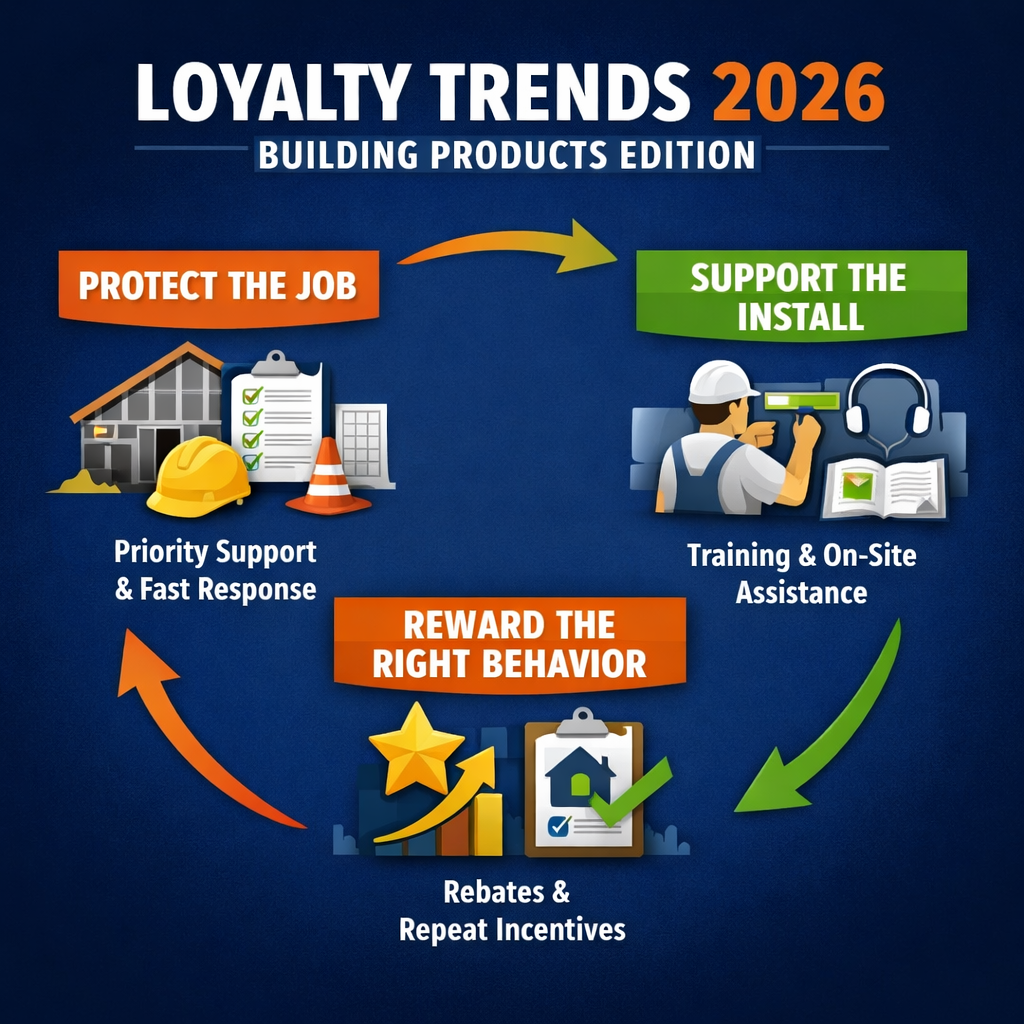
If you do nothing else, build your program around these three outcomes:
-
Make it easier to choose you (spec tools, assemblies, documentation, training)
-
Make it safer to install you (support, claims response, quality reinforcement)
-
Make it smarter to stick with you (status, value stacking, business growth benefits)
And here’s the truth: the brands that win in 2026 won’t be the ones with the flashiest rewards catalog. They’ll be the ones who treat loyalty like a serious, engineered system that protects the job, respects the customer, and creates compounding advantage.
Points are fine. Trust is better. And fewer callbacks is basically romance in the trades.
If you want, I can also turn this into:
-
a 2026 loyalty program framework by audience (architect vs builder vs installer vs designer vs remodeler)
-
a tier and benefits matrix
-
sample KPI dashboard and ROI model
-
a 12-month activation calendar tied to trade events and seasonal project cycles
About Draper DNA
Draper DNA is a marketing consultancy that speaks fluent building products. We help manufacturers turn complex channels into competitive advantage by designing strategies that connect specification to installation to repeat purchase. Our work sits at the intersection of brand, demand, and loyalty, where the real decisions get made and the real value gets created.
When it comes to loyalty marketing, we don’t start with points. We start with behavior. Draper DNA helps building products manufacturers design and implement custom loyalty ecosystems that reward the actions that actually grow the business: correct specification, confident installation, repeat use, advocacy, and long-term partnership. That means building programs that work across architects, builders, contractors, designers, remodelers, and distributors, not just one audience in isolation.
Our team brings deep category experience, from channel mapping and audience segmentation to program architecture, benefit design, technology selection, and rollout planning. We help you define the right value exchange, build the operating model, and activate it across sales, marketing, training, and service so loyalty becomes part of how your business runs, not just another campaign.
If you’re ready to reduce switching, protect margin, and turn your best partners into your strongest growth engine, Draper DNA can help you build a loyalty program that earns its keep. Let’s design one that works as hard as your customers do.