Lighting trends for 2026: what to build, what to stop building, and what to market like you mean it
January 9, 2026
.
If you make lighting products and you’re planning for 2026, here’s the uncomfortable truth: the market is done rewarding incremental upgrades. Another “sleeker cylinder” won’t save you. What will? Fixtures, optics, controls, and claims that are measurably better for people, the grid, and the planet, and that can be proven in specs, not vibes.
Below are the lighting trends that will matter in 2026, why they’re happening, and what they mean for product manufacturers trying to win in residential, light commercial, and specification-driven projects.
The big forces pushing these trends (and why they’re not going away)
1) Efficiency is table stakes, and regulation keeps tightening.
In the U.S., DOE continues updating energy conservation standards for general service lamps (GSLs). That shapes what’s viable at mass scale and what retailers and utilities will push. The Department of Energy’s Energy.gov+1
In the EU, ecodesign requirements for light sources and control gear are mandatory for anything sold into that market, and broader sustainable product rules are moving toward a 2026-ish reality for many categories. Energy Efficient Products+1
2) “Health and wellness” lighting is shifting from marketing poetry to metrics.
Designers and owners increasingly talk about circadian-supportive lighting using recognized approaches like melanopic-based metrics in WELL v2 and guidance like UL’s circadian entrainment design guideline. WELL Resource Hub+1
3) Lighting is becoming furniture, architecture, and software at the same time.
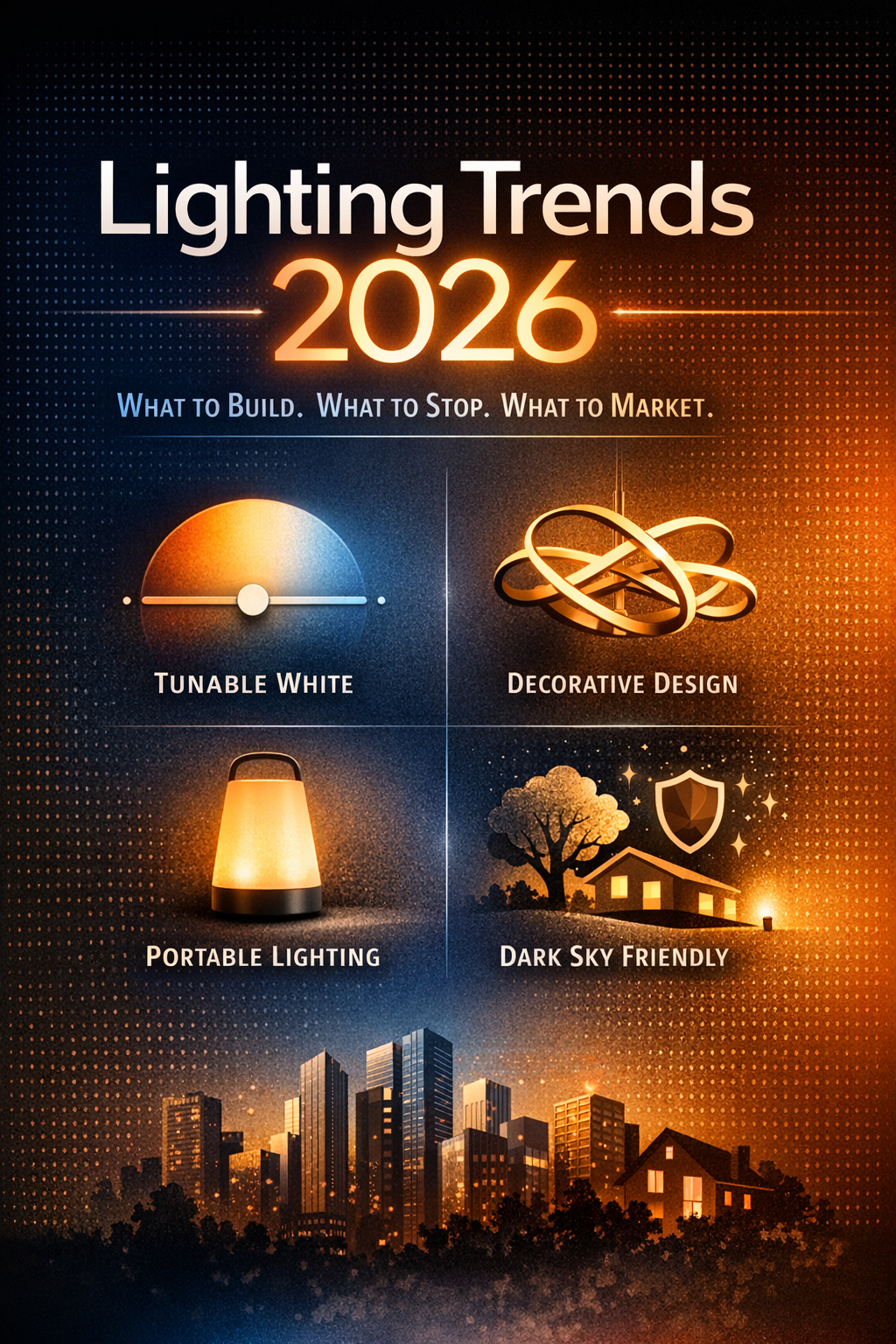
Design trends for 2026 emphasize layered, intentional lighting, sculptural statement fixtures, discreet linear elements, tunable white, and portable rechargeable lamps. Veranda
Meanwhile, outdoor lighting is under growing scrutiny for light pollution and ecological impact, with programs like DLC’s LUNA pushing better spectral/distribution/controls expectations. DesignLights+2DesignLights+2
10 lighting trends to prepare for in 2026 (with implications for manufacturers)
1) Layered lighting replaces “one big light and a prayer”
Designers are moving away from “ceiling can grid = done” toward intentional layers: ambient + task + accent + decorative. The consumer version is “make my house feel expensive.” The spec version is “give me flexibility without glare.” Veranda
Manufacturer implications
-
Build families that make layering easy: downlights + wall wash + undercabinet + decorative, with consistent CCT/dimming behavior.
-
Provide photometry and application guides that help designers compose light, not just buy SKUs.
2) Recessed lighting gets demoted, not deleted
Recessed is still useful. But it’s no longer the star of the show. It becomes infrastructure: quiet, precise, glare-controlled, and paired with other sources. Veranda
Manufacturer implications
-
Prioritize visual comfort: tighter cutoffs, better shielding, better beam options, and credible UGR/glare narratives (with real data).
-
Improve dimming performance and low-end stability. “Dims to 10%” is not a flex anymore.
3) Decorative fixtures go sculptural (lighting as jewelry)
Statement pendants, chandeliers, and architectural pieces are trending because people want focal points and personality. Think “lighting as art,” not “lighting as appliance.” Veranda
Manufacturer implications
-
Materiality matters: metal finishes, glasswork, textiles, craftsmanship stories.
-
Modular systems (sizes, shapes, finishes) let designers spec a look without begging for custom.
4) Tunable white becomes mainstream, especially in premium residential and workplace
Tunable white isn’t new, but 2026 is when it stops being a novelty and becomes a default expectation in higher-end projects because it improves mood, supports different tasks, and aligns with circadian conversations. Veranda+1
Manufacturer implications
-
Invest in tunable + dimming compatibility and publish compatibility lists. “It flickers sometimes” is not a user experience, it’s a lawsuit waiting to happen.
-
Package tunable white as scenes (Focus, Everyday, Wind Down) with intuitive controls, not as “2700–6500K” tech-speak.
5) Circadian and wellness lighting gets more serious (and more scrutinized)
Owners are hearing about melanopic measures (WELL) and design approaches intended to support circadian entrainment (UL guidance). That raises expectations and also raises the bar for claims. WELL Resource Hub+1
Manufacturer implications
-
Be careful with health claims. Lead with design guidance + transparency: spectral data, recommended settings, and intended-use scenarios.
-
Create “spec-ready” wellness packages: documentation that supports WELL-aligned strategies (where applicable) and guidance that doesn’t overpromise. WELL Resource Hub+1
6) Color quality moves beyond CRI (TM-30 becomes a differentiator)
CRI is the training wheels. Specifiers increasingly want richer color information, and TM-30 is a more robust way to describe color rendition. IES+1
Manufacturer implications
-
Publish TM-30 metrics for core product lines, especially in retail, hospitality, museums, and residential “high design.”
-
Use TM-30 to segment products by application (food, fashion, art, healthcare) instead of pretending one LED works for everything.
7) Portable, rechargeable lamps keep climbing (cords are out, vibe is in)
Rechargeable lamps are becoming the new candles: flexible, movable, and mood-forward. The category still struggles with brightness and battery life, but demand is real. Veranda
Manufacturer implications
-
If you play here, win on the basics: battery longevity, stable dimming, quality warm light, durability, charging experience.
-
Retail packaging and merchandising matter more than usual in this segment. It’s a “pick me up in-store” product.
8) “Invisible” lighting grows: linear, cove, graze, and glow lines
Discrete linear lighting is gaining popularity because it delivers atmosphere without visual clutter. Veranda
Manufacturer implications
-
Tighten your system approach: channels, diffusers, corners, connectors, drivers, and install accessories.
-
Make it idiot-resistant. Linear fails in the field when installers have to improvise.
9) Outdoor lighting gets judged for darkness, not brightness
More owners are reacting to glare, trespass, and sky glow. DLC’s LUNA requirements push attention to distribution, spectrum, and controllability for outdoor LED products. DesignLights+2DesignLights+2
Manufacturer implications
-
Expand warm CCT + spectrum-aware outdoor options where appropriate.
-
Make controls and dimming profiles standard, not “premium upgrades.”
-
Provide documentation that helps municipalities and campuses defend choices.
10) The label landscape is shifting (and you need a plan)
EPA sunset the ENERGY STAR specifications for lamps and luminaires as of December 31, 2024, with downlights handled under a separate specification. That changes how some buyers interpret “qualified” and how some programs structure incentives. ENERGY STAR+2ENERGY STAR+2
Manufacturer implications
-
Audit your sales enablement: if your pitch leans heavily on “ENERGY STAR certified,” update it yesterday.
-
Replace label-centric messaging with performance proof: efficacy, dimming, glare control, color quality, controllability, and documented outcomes.
What this means for product manufacturers: the 2026 playbook
Product strategy: build platforms, not one-offs
2026 winners will offer coherent product ecosystems: tunable downlights that match decorative warmth, linear systems that share drivers and controls, outdoor lines with distribution options and controls baked in. Layering and consistency beat “look how many SKUs we have.”
Engineering: the quiet stuff sells now
Glare control. Dimming smoothness. Driver quality. Compatibility. Flicker behavior. Thermal management. These aren’t sexy. They’re why returns happen (or don’t).
Compliance and sustainability: document like you’ll be cross-examined
Between EU ecodesign requirements and broader sustainable product direction, plus tightening expectations in other markets, documentation becomes part of the product. Energy Efficient Products+1
The same goes for energy standards in the U.S. The Department of Energy’s Energy.gov+1
Go-to-market: stop selling features, start selling outcomes
Nobody wakes up wanting “higher efficacy.” They want:
-
a kitchen that feels expensive at 8pm,
-
an office that doesn’t give people headaches,
-
a campus that’s safer without blasting the night sky,
-
a retail environment where products look right.
Tie your product story to those outcomes, backed by data (TM-30, photometry, controls behavior, spectral reporting) rather than adjectives. IES+1
Where Draper DNA fits: turning lighting trends into revenue (not just content)
A lot of manufacturers can build what the market wants. Fewer can explain it clearly enough to earn specification, preference, and margin.
That’s the lane Draper DNA plays in: translating technical value into market value across channels. Not “rebrand and pray,” but practical strategy:
-
Trend-to-roadmap workshops: which trends matter for your categories and customers, and which are distractions.
-
Spec and sales enablement: performance proof points, comparison tools, and messaging that survives the jobsite.
-
Content that drives action: education that earns trust with architects, designers, builders, and distributors (without reading like a product brochure with a dimmer switch).
-
Channel planning: aligning distributors, reps, e-comm, and spec so you’re not telling four different stories to the same buyer.
If 2026 is the year lighting becomes more layered, more measured, and more scrutinized, the brands that win will be the ones who can prove performance and market it without sounding like they swallowed a datasheet.
And yes, you still need pretty pictures. But in 2026, pretty pictures without proof are just expensive mood boards.