Children’s Bedroom Design Trends to Prepare for in 2026
January 29, 2026
.
A practical (and slightly mischievous) guide to what’s coming, what parents will actually buy, and what product manufacturers should do about it.
Kids’ bedrooms have always been a tug-of-war between imagination and reality. The imagination wants a rocket ship bed, a glow-in-the-dark galaxy ceiling, and a pet dinosaur. Reality wants a room that’s safe, calm, cleanable, and not redecorated every nine months because a six-year-old discovered a new personality.
What’s changing as we head into 2026 is who’s winning that tug-of-war. Parents are still saying “fun,” but they’re increasingly paying for function, health, longevity, and flexibility. Meanwhile, kids (Gen Alpha and the youngest Gen Z) are more design-literate than we were at 30. They notice quality. They want control. And they absolutely will roast your “theme room” in two years.
Here are the trends worth preparing for in 2026, with concrete implications for manufacturers in furniture, lighting, paint, storage, flooring, textiles, wall systems, and decor.
1) The end of babyish “kid decor” and the rise of “future-proof” rooms
The 2026 kids’ room is less cartoon set, more starter apartment with personality. Parents are leaning into rooms that can evolve from toddler to teen with fewer big-ticket replacements.
What it looks like
-
Beds and casegoods with cleaner lines, fewer character motifs
-
“Grows with them” dimensions and features: adjustable shelving, convertible beds, modular desks
-
Decor that’s easy to swap: art rails, peel-and-stick zones, textiles as the statement layer
Why it’s happening
-
Families are tired of the expensive reset cycle
-
Kids’ tastes shift fast, and parents know it
-
A calmer baseline supports sleep, learning, and behavior (more on that below)
Manufacturer implications
-
Design product families with consistent systems: the same dresser works in a nursery and later in a tween room with a different top kit or hardware option
-
Make replacement parts and add-ons easy to find (parents love upgrades more than replacements)
-
Sell the room as a “platform,” not a single moment in time
2) Storage becomes architectural, not accessory
In 2026, storage isn’t a basket problem. It’s a room-planning strategy. Expect more built-in-looking solutions that don’t require a contractor, because parents want order without the home-equity loan.
What it looks like
-
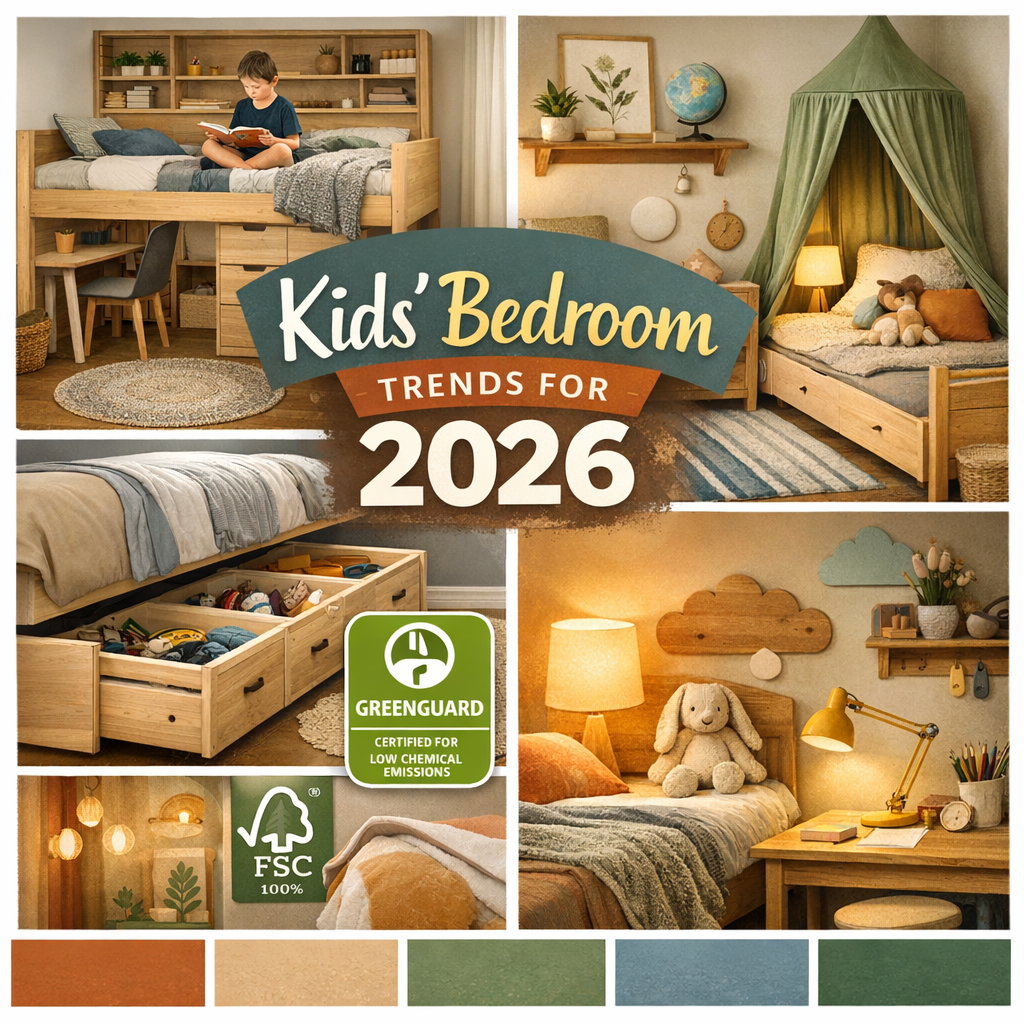
Storage beds and “built-in bed” setups that reclaim floor space
-
Vertical storage walls, book ledges, cubbies that look intentional
-
Under-bed drawers that don’t jam after three weeks of Lego dust
This is showing up clearly in consumer content around kids’ rooms and small bedrooms, with storage beds positioned as a core tactic for function and clutter control. Los Angeles Times
Manufacturer implications
-
Treat storage as a primary product category, not an upsell
-
Engineer for real life: drawer slides, soft-close, anti-tip, and materials that survive impact and spills
-
Create modular storage “zones” that work with common room sizes and rental constraints
-
Build bundles: bed + headboard storage + matching wall shelves + toy management (parents will pay to be done thinking)
3) Warm, grounding color replaces pastels and cold grays
Kids’ rooms are swinging away from icy pastels and sterile gray toward warmer, more comforting color stories. Designers are actively calling out cool grays and washed-out pastels as colors that will feel dated heading into 2026. Good Housekeeping
At the same time, broader 2026 palette predictions lean into warm earth tones, plus playful-but-grown-up pairings (blue/yellow, powder blue/burgundy, blush/forest green). Southern Living
What it looks like
-
Soft clay, warm taupe, olive, buttercream, muted denim
-
Accent colors used in textiles and art rather than one aggressive “theme wall”
-
Rooms that feel cozy instead of “sugar rush”
Manufacturer implications
-
Paint and wallcovering brands should push family-friendly warm neutrals with easy coordination
-
Flooring and casegoods should lean into warmer wood tones and matte finishes (less glare, more calm)
-
Offer curated palette kits by age range: preschool, grade school, tween
4) “Nature inside” goes mainstream: biophilic kids’ rooms
Biophilic design isn’t just for spas and boutique hotels anymore. The research basis keeps strengthening around nature-connected environments supporting children’s well-being, and the design world is translating that into materials, light, and visuals. Children & Nature Network+2PMC+2
What it looks like
-
Natural textures: wood, woven, linen/cotton, wool blends
-
Nature motifs: botanical wall art, landscape murals, animal forms done in a modern way
-
Better daylighting and layered lighting, not one overhead blast
Manufacturer implications
-
Push material transparency: species, sourcing, finishes
-
Pair “nature-inspired” with performance claims that matter to parents: cleanability, durability, low emissions
-
Consider product storytelling that connects to learning: “Why wood grain varies,” “How plants improve a space,” etc.
5) Non-toxic, low-emission materials become a purchase requirement
Parents are not just asking “Is it cute?” They’re asking “What’s in it?” and “What will it off-gas into my kid’s lungs?”
This isn’t paranoia; it’s purchasing logic. Composite wood products sold in the U.S. are covered by EPA formaldehyde emissions standards (TSCA Title VI). US EPA+1 And third-party indoor air certifications like UL GREENGUARD Gold are explicitly positioned for sensitive environments including homes and schools. UL Solutions
What it looks like
-
GREENGUARD Gold and similar certifications used as decision shortcuts
-
More demand for low-VOC finishes, safer adhesives, and clearer labeling
Manufacturer implications
-
Make compliance and certification visible and simple: product pages, packaging, retailer training
-
Build marketing around “clean air” without sounding like a conspiracy podcast
-
Treat chemical disclosure as brand equity, not legal fine print
Bonus: sustainable sourcing certifications are getting more consumer attention (and scrutiny), with FSC commonly cited as more stringent than many alternatives. The Guardian
6) Safety is design: bunk beds, lofts, and elevated sleep get smarter
Bunk beds and loft solutions are hot again because they unlock floor space and support shared rooms and sleepovers. But safety requirements aren’t optional. U.S. regulations for children’s bunk beds address guardrails and entrapment risks (among other hazards). U.S. Consumer Product Safety Commission+1
What it looks like
-
Better ladder ergonomics and grips
-
Guardrails that look intentional, not tacked-on
-
Configurations that reduce wall gaps and entrapment points
Manufacturer implications
-
Design compliance into the aesthetic so it doesn’t look like a compromise
-
Produce simple consumer education: how to place bunk beds, what mattress heights are allowed, why guardrails matter
-
Retailers need training, too. A compliant product loses power if it’s displayed or explained poorly
7) Lighting shifts from decorative to behavioral
In 2026, lighting in kids’ rooms is less about “cute lamp” and more about sleep rhythm, homework focus, and sensory comfort.
There’s strong evidence that evening light exposure affects melatonin and circadian timing, and kids can be especially responsive. PMC+2Nature+2
Meanwhile, smart lighting is becoming easier to deploy across ecosystems thanks to Matter and platform features like adaptive lighting that shifts color temperature through the day. The Verge
What it looks like
-
Dimmable, warm bedside lighting for evenings
-
Brighter task lighting for desks and crafts
-
Night lights that reduce fear without turning the room into a casino
Manufacturer implications
-
Offer lighting “recipes” (morning, homework, wind-down) as part of the product experience
-
Build fixtures with controls parents actually use: presets, simple dimming, kid-safe switches
-
If you sell smart, sell it with guardrails: privacy messaging, device policies, and “no, your five-year-old doesn’t need a voice assistant in their bed”
8) Sensory-friendly design becomes a mainstream expectation
This isn’t only about neurodivergent families, but they’re helping define best practices for everyone: softer acoustics, dimmable lighting, reduced visual chaos, cozy corners, and rooms that support regulation. Combine that with the broader move toward calmer palettes and you get a powerful 2026 direction.
What it looks like
-
Blackout or room-darkening window treatments
-
Soft textures and rugs that dampen sound
-
A “calm corner” (beanbag, canopy, reading nook)
-
Cleaner wall zones with fewer overstimulating patterns
Manufacturer implications
-
Lean into rounded edges, soft-close, anti-tip, and tactile materials
-
Market the benefit plainly: “less glare, less noise, more calm”
-
Build product photography that shows real rooms, not a maximalist toy explosion staged by someone who’s never met a child
What this means for product manufacturers
Let’s break it down into moves you can actually make before 2026 hits:
-
Build modular product ecosystems
Families want solutions that scale. Create systems that can be reconfigured with add-ons instead of replaced. -
Make health and safety proof easy to find
Compliance and certifications shouldn’t be a scavenger hunt. Put it on the PDP, on the box, in the sales deck. -
Design for clutter reality
Storage is now a core function. Engineer it like it matters, because it does. -
Own the “calm + creativity” balance
The winning brands won’t sell sterile minimalism. They’ll sell a calm base layer that still leaves room for personality. -
Tie smart features to human outcomes
Parents don’t care that your light has 16 million colors. They care that bedtime stops being a nightly negotiation.
Where Draper DNA fits
This is the kind of trend shift that punishes brands that only “add a few new SKUs” and hope retailers figure it out.
Draper DNA helps building-products and home-category manufacturers translate trends into:
-
Product positioning that parents trust and kids actually like
-
Channel strategy that works across dealer, retail, DTC, and pro
-
Storytelling and content systems that turn safety, sustainability, and flexibility into demand drivers
-
Launch plans that coordinate merchandising, creator content, PR, and paid media so the message lands the same way everywhere
In other words: we help you move from “we have products” to “we own the category story.” And in 2026, the category story is health, adaptability, calm, and design intelligence. (Yes, even for kids. Especially for kids.)
The bottom line
The children’s bedroom in 2026 is not a toy chest with a mattress. It’s a behavioral environment: sleep, learning, play, regulation, growth, and identity all happen there.
Brands that win will design rooms that:
-
evolve instead of expire
-
store instead of sprawl
-
soothe without boring
-
prove safety and low emissions without hand-waving
-
use tech to support routines, not hijack them
If you’re a manufacturer and you want to be on the right side of that shift, start building now. Kids grow fast. Expectations grow faster.