Advertising in 2026: What Building-Products Manufacturers Need to Get Right (Before Your Customers Get There Without You)
February 1, 2026
.
If you sell building products, you’re not advertising to “the market.” You’re advertising to a supply chain with opinions.
Architects want confidence and proof. Builders want speed and fewer callbacks. Contractors want clarity and availability. Designers want story and aesthetics. Remodelers want differentiation and margin. Homeowners want reassurance and a reason to care.
In 2026, the biggest advertising trends are basically forcing one conclusion: if you can’t connect your message to real outcomes, in the exact moment your customer is deciding, you’re paying to be politely ignored.
Here are the trends that matter, and how to apply them specifically to building products.
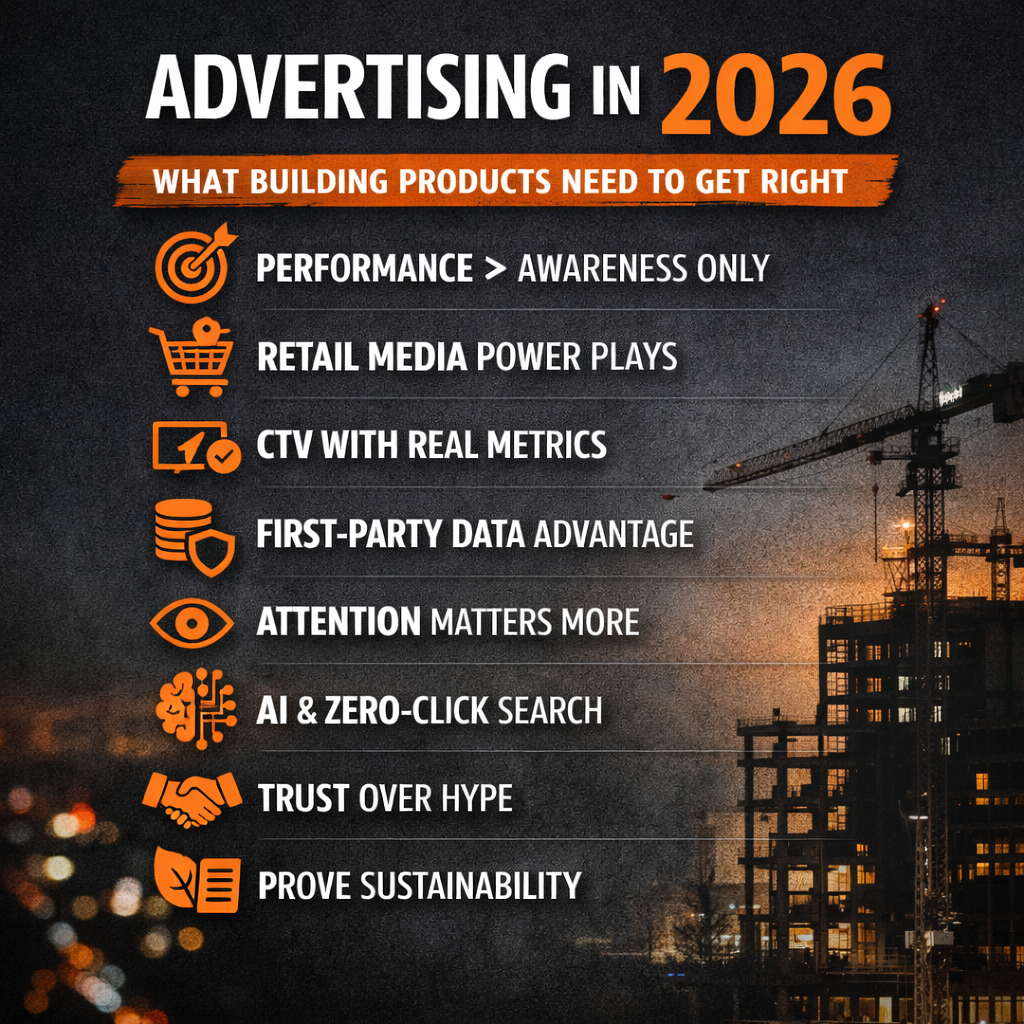
1) Performance pressure is eating “awareness-only” budgets alive
The money is still there. But the tolerance for vague, feel-good campaigns is not.
Digital ad revenue keeps growing, and so does the expectation that every dollar shows return. IAB reports 2024 internet ad revenue hit $258.6B (up 14.9% YoY). Commerce-related ad spend is a major driver, with retail media network revenue at $53.7B in 2024 (up 23% YoY).
What this means for building products:
-
Stop running “brand” and “lead gen” as two separate universes. Your brand claim should create a measurable action.
-
Every big message needs a down-funnel proof point: spec download, detail request, sample order, installer lookup, quote request, dealer locator, takeoff support, warranty registration, jobsite checklist.
Concrete move for 2026:
Build campaigns in pairs:
-
Primary: “Why this matters” (architect/designer story, category leadership)
-
Proof: “Here’s what it does” (install time saved, performance in real conditions, fewer steps, better moisture control, etc.)
2) Retail media and commerce ecosystems are no longer “nice to test”
Retail media is expanding beyond CPG into categories that have historically been under-digitized. WARC forecasts global retail media spend hitting $196.7B in 2026 and notes retail media investment could overtake combined linear + connected TV spend in 2026.
Even if you don’t sell “through” Amazon the way consumer brands do, your customers increasingly behave like modern buyers: they research, compare, and buy inside a handful of platforms and distributor ecosystems.
What this means for building products:
-
If your products are available through big-box, specialty retail, or distribution networks with digital ordering, retail media is where you win share at the decision point.
-
If you’re not ready for full retail media, you should still copy the playbook: product-level targeting, SKU-level creative, conversion reporting, and tight coordination with channel partners.
Concrete move for 2026:
Run a three-tier program:
-
Search capture (category + competitor conquest)
-
Mid-funnel education (comparison charts, “spec-to-site” explainers)
-
Conversion assists (store availability, installer match, rebates, delivery promise)
3) CTV is maturing fast, and it’s becoming measurable enough to matter
Streaming keeps taking viewing time, and ad dollars follow attention. eMarketer notes streaming reached 45.7% of all TV viewing time (Oct 2025) and forecasts US CTV ad spend at $32.45B in 2025, with continued growth toward a streaming-first future.
Meanwhile, surveys show marketers are prioritizing cookieless solutions, cross-media measurement, and AI-driven creative personalization as they shift toward streaming environments.
What this means for building products:
-
CTV is perfect for showing what a product does in the real world: water management, install steps, sound reduction, fire rating, thermal performance, finishes, transformations.
-
The mistake is treating CTV like old TV: one pretty spot, hope for the best.
Concrete move for 2026:
Use CTV as the top of a measurable sequence:
-
CTV video → retarget by geography/trade audience → drive to a specific action (spec package, sample kit, contractor training signup).
-
Build “project-type creatives” (coastal, high-humidity, wildfire regions, multifamily acoustics, etc.) and rotate by region.
4) Third-party cookie uncertainty isn’t over—but it’s no longer the main story
Google has shifted away from fully removing third-party cookies in Chrome, and is leaning toward user controls and ongoing Privacy Sandbox development.
Here’s the thing: whether cookies “die” or “limp along,” the direction is the same. Targeting and measurement get harder unless you own more of the relationship.
What this means for building products:
-
Your first-party data is not just homeowners. It’s architects downloading details, builders requesting takeoffs, contractors attending trainings, designers ordering samples, remodelers using your dealer locator.
-
If you don’t capture and connect those signals, you’ll keep paying to reacquire the same people.
Concrete move for 2026:
Create a simple “value exchange ladder”:
-
Anonymous: calculators, visualizers, quick guides
-
Known: spec downloads, detail libraries, sample requests
-
Qualified: project support, installer certification, co-op programs
Then use clean, permissioned segmentation for advertising and nurture.
5) Attention measurement is replacing impression worship
Impressions are easy to buy. Attention is harder—and increasingly the metric that matters. IAB has formalized frameworks for measuring attention consistently across environments.
What this means for building products:
-
Your buyer cycle is long and multi-touch. Paying for “viewable” ads that nobody actually processes is a slow leak in your budget.
-
In categories where safety, durability, and compliance matter, attention correlates with trust.
Concrete move for 2026:
Test “attention-first” placements and creative formats:
-
Longer-form CTV and YouTube placements for installers and builders
-
High-attention native placements in trade publications
-
Interactive units: “choose your assembly,” “compare wall sections,” “see install steps”
Then optimize toward quality engagement (time, completion, saves, spec actions), not just CTR.
6) AI is changing creative production, but it’s also changing discovery
AI isn’t just a tool for making ads. It’s also rewriting how people find information.
Pew found that when Google users encountered an AI summary, they clicked traditional search links 8% of the time, vs 15% when there was no AI summary.
Translation: your future customer may “get the answer” without ever visiting your site.
What this means for building products:
-
Your content has to be structured so it can be cited, summarized, and trusted.
-
Your advertising has to assume fewer organic clicks and more “zero-click research.”
Concrete move for 2026:
Build “citation-ready” assets:
-
crisp spec claims with references
-
clear installation steps and constraints
-
code compliance language
-
region-specific performance notes
Then use paid to distribute those assets where your audiences already live (trade channels, CTV, retail ecosystems, LinkedIn).
7) B2B trust-building is the new targeting
When the product is expensive, installed, and expected to perform for decades, trust beats clever.
Edelman and LinkedIn’s B2B thought leadership research emphasizes that strong thought leadership builds trust and opens doors where traditional advertising struggles.
What this means for building products:
-
Architects don’t want to be “marketed to.” They want to be supported.
-
Builders and contractors don’t want hype. They want fewer problems on site.
-
Designers want confidence they won’t be blamed when something fails.
Concrete move for 2026:
Run “proof-based thought leadership” as advertising:
-
short, punchy field insights (what fails, why it fails, how to avoid it)
-
assembly-level education
-
jobsite checklists
-
case studies with measurable outcomes
Then amplify it with paid distribution to specific roles and regions.
8) Sustainability claims are under a microscope
“Sustainable” is no longer a vibe. It’s documentation, transparency, and proof. Marketers are elevating environmentally sustainable advertising as a strategic priority in Europe, alongside measurement and targeting improvements.
What this means for building products:
-
If you make environmental claims, be ready to back them up (EPDs, HPDs, certifications, lifecycle framing).
-
If you don’t, you still need a responsible performance narrative: durability, reduced waste, fewer replacements, healthier interiors.
Concrete move for 2026:
Turn sustainability into decision tools:
-
“Which assembly meets this goal?” guides
-
compliance-ready spec language
-
training that helps pros explain value to homeowners
The 2026 Playbook for Building Products Advertising (Quick, Practical, Non-Theoretical)
If you want an unfair advantage in 2026, do these five things:
-
Map the decision chain (architect → builder → contractor → homeowner) and write ads that anticipate objections at each handoff.
-
Use video where performance is visual (water, fire, sound, install) and tie it to measurable actions.
-
Treat retail/distribution ecosystems as media channels, not just sales channels.
-
Build first-party signals intentionally (samples, specs, trainings, tools) and stop relying on borrowed targeting.
-
Optimize toward attention and proof, not vanity metrics.
Do that, and you’ll spend less time explaining yourself—and more time getting specified, stocked, and installed.
Draper DNA
Draper DNA is a marketing consultancy and creative partner built for the building-products world. We help manufacturers translate technical performance into clear, persuasive advertising that moves through the full chain: architect, builder, contractor, designer, remodeler, and homeowner. Our work connects brand strategy to real outcomes with campaigns designed for modern media realities, including CTV, retail media, paid social, and privacy-first targeting.
If you’re ready to turn your product story into advertising that actually performs, Draper DNA can create custom ad concepts, messaging, and multi-channel campaign systems tailored to your category, region, and customer mix. Bring us your product, your goals, and your constraints—and we’ll build the creative and media approach that earns attention, wins trust, and drives demand.
If you want custom advertising built specifically for your brand and your channels, reach out to Draper DNA to start a working session and leave with a campaign direction you can put into market.