Social Media in 2026 for Building Products Manufacturers: What Changes, What Wins, What Breaks
February 1, 2026
.
If your 2026 social plan is basically “post more project photos,” I have good news and bad news.
Good news: the bar is still low in building products.
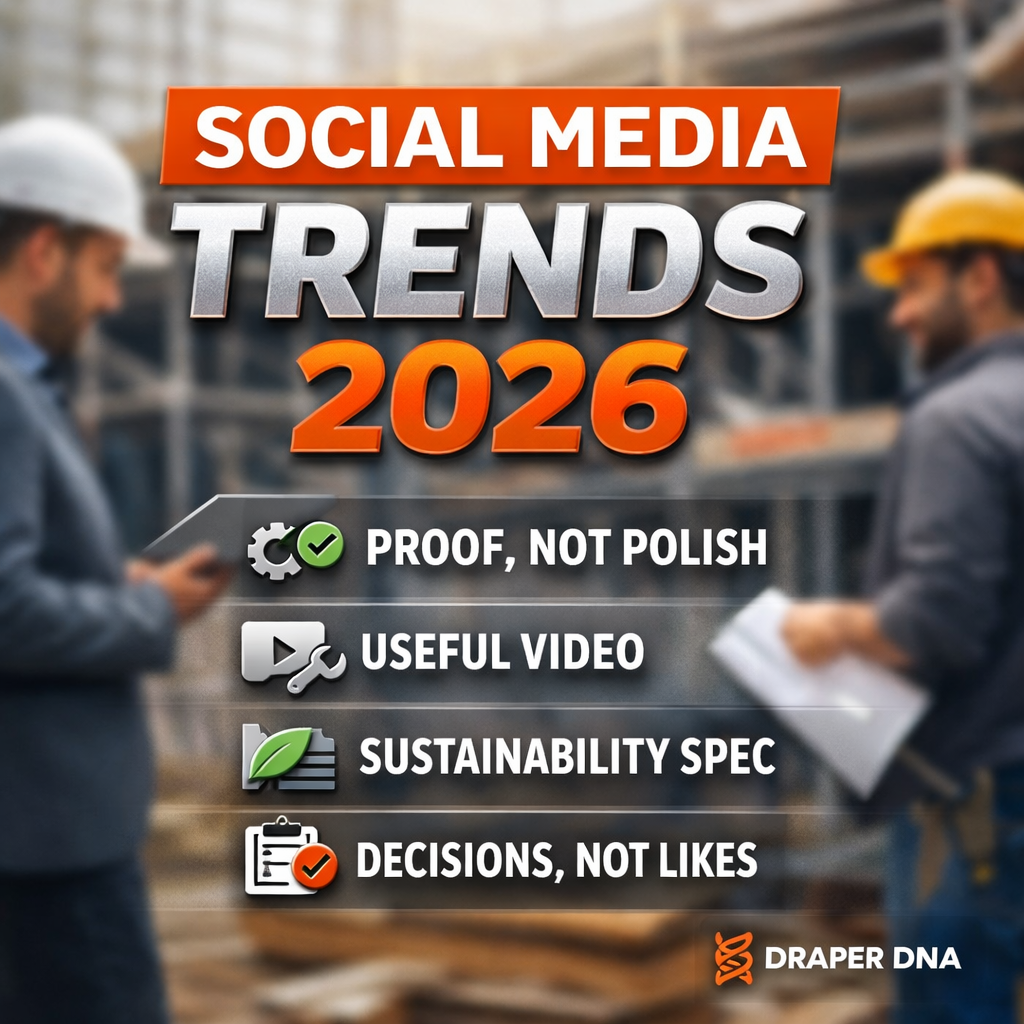
Bad news: the internet has evolved, your customers have evolved, and the platforms are evolving in real time. The brands that win in 2026 won’t be the loudest. They’ll be the clearest: the ones that teach, prove, and show up consistently where architects, builders, contractors, designers, and remodelers actually make decisions.
Here are the trends worth caring about in 2026, and how to apply them without turning your feed into an inspirational poster factory.
Trend 1: Social becomes the front door to discovery, not the “awareness layer”
Search is being reshaped by generative AI and answer engines, and audiences are increasingly discovering brands inside social platforms before they ever search the open web. That changes the job of social: it’s no longer just storytelling. It’s discoverability, proof, and pre-sales.
What this means for building products
Your social content has to function like a product experience:
-
What is it? (category clarity)
-
Where does it belong? (application clarity)
-
Why should I trust it? (proof)
-
How do I specify or buy it? (path to action)
Practical moves
-
Build a “specifier’s table of contents” as a pinned series: fire rating, acoustics, thermal, moisture, durability, warranty, install, sustainability documentation.
-
Make “how to choose” content searchable inside platforms: short titles, obvious keywords, consistent naming (don’t rename your product every quarter because someone got excited in a meeting).
Trend 2: Video is still king, but 2026 rewards “useful video,” not “pretty video”
The trend headlines keep saying “video wins,” but the nuance matters. In 2026, video that performs is practical: explainers, demos, comparisons, and jobsite-reality content that helps people decide faster. Sprout and LinkedIn both continue to emphasize video’s role in attention and sharing, especially in B2B contexts.
What this means for your audiences
-
Architects: want clarity, performance, detailing guidance, and documentation.
-
Builders/GCs: want schedule protection, fewer callbacks, predictable results.
-
Contractors/installers: want speed, fewer steps, fewer failures.
-
Designers: want aesthetics + performance + confidence they won’t get blamed later.
-
Remodelers: want before/after, problem solving, and client-friendly language.
Video formats that actually move product
-
60–90 second “Field Notes”: one problem, one fix, one product proof point.
-
Detail breakdowns: zoom-in framing, annotated overlays, “do this, not that.”
-
Comparison videos: “If you’re in X climate, here’s why Y assembly fails.”
-
Myth-busting: the fastest way to earn trust is to correct bad assumptions politely… then back it with evidence.
Trend 3: Serialized content beats random acts of posting
One-off posts are snack food. Series build memory. Sprout specifically calls out serialized/original content series as an attention and retention driver.
What this means for building products
You’re not selling a vibe. You’re selling decisions with consequences: cost, risk, code, warranty, client satisfaction. Series let you teach in a way your market can binge.
Series ideas that fit building products like a glove
-
“Spec-to-Site: 10 Details That Prevent 10 Headaches”
-
“Moisture Myth Monday” (yes, Monday is fine; chaos is already here)
-
“Ask a PM”: what slows projects down, and how product choices affect it
-
“Remodel Reality”: the three conditions remodelers meet every week and how to plan for them
Trend 4: AI content is everywhere, so trust becomes a strategy, not a tone
AI-assisted content creation is going mainstream; the predictable side effect is a flood of generic posts. Platforms and audiences will reward brands that feel human, specific, and accountable. Sprout’s forward-looking guidance also flags growing consumer wariness about undisclosed AI content.
What this means for you
Use AI to speed up production, not to replace judgment.
2026 trust signals for building products brands:
-
named experts (real people)
-
jobsite footage (real environments)
-
real constraints (weather, schedule, labor, budget)
-
real documentation (tests, approvals, EPDs, ICC-ES where relevant)
-
real accountability (how you handle failures and warranties)
A boring truth beats a beautiful half-truth every time.
Trend 5: Sustainability shifts from marketing claim to spec requirement
Architects and many commercial/residential programs are moving deeper into embodied carbon, transparency, and material stewardship. NCARB is explicitly talking about resource scarcity/volatility and a looming “materials crisis.”
What this means for building products manufacturers
Sustainability content can’t be a one-page brochure. It needs to be usable:
-
EPD explainers (what it is, where to find it, how to interpret it)
-
clear statements on recycled content, sourcing, and manufacturing footprint
-
guidance on assemblies and best practices that protect performance over time
Also: if your sustainability story is “we care,” congratulations—you’ve met the minimum requirement for not getting laughed out of the room.
Social content that helps specs move faster
-
“EPD in plain English” micro-series
-
“How to answer the three sustainability questions your architect will ask”
-
“What this product does in a whole-wall/whole-roof assembly” (because no one specs in isolation)
(And yes, EPDs are becoming central enough that mainstream industry guidance keeps reinforcing them.)
Trend 6: The construction economy is choppy, so your customers want risk reduction
Architecture billings and leading indicators have been soft, and forecasts are mixed by sector, with ongoing uncertainty.
What this means for your messaging
In uncertain cycles, people buy fewer experiments and more certainty.
So your 2026 content should emphasize:
-
performance predictability
-
install reliability
-
reduced rework and callbacks
-
documentation that stands up to scrutiny
-
availability and lead-time transparency (when you can)
If you can prove you protect schedules and outcomes, you become the safer choice. And “safe choice” is not an insult in construction. It’s the goal.
Trend 7: Measurement gets stricter, and “likes” are officially demoted
B2B platforms and marketing leaders are pushing harder on measurement that connects to revenue impact, pipeline quality, and real business outcomes. LinkedIn is explicit that measurement frameworks are a competitive advantage in 2026.
What this means for building products social teams
Your KPI stack should look like this:
Level 1: Market visibility
-
share of voice for category terms
-
reach within geo/vertical targets
-
video completion rates on key educational assets
Level 2: Trust and engagement
-
saves, shares, DM replies
-
comment quality (questions beat emojis)
-
click-through to spec resources
Level 3: Commercial outcomes
-
spec downloads
-
rep inquiries
-
samples ordered
-
distributor/dealer referrals
-
inbound leads tagged to content themes
If you can’t tie content themes to downstream actions, you’re doing entertainment, not marketing.
How to turn these trends into a 2026 program your channel can actually use
Here’s a clean operating model that works for manufacturers selling through spec and trade:
1) Build five content pillars (not twenty)
-
Performance + compliance
-
Installation + field proof
-
Design + aesthetics
-
Sustainability + documentation
-
Project stories + customer outcomes
2) Map pillars to audiences (architect vs builder vs contractor, etc.)
Same pillar, different angle. One post becomes five variations without becoming five identical posts wearing different hats.
3) Produce content in “packs”
Every month, create:
-
2 short videos (field/demo)
-
1 carousel or PDF-style post (spec education)
-
1 case study post (project proof)
-
1 live Q&A or “ask us anything” moment
4) Give sales and reps a playbook
If your team can’t share it in 10 seconds, it won’t get shared.
Provide:
-
suggested post text
-
who it’s for
-
when to use it (new project, VE question, substitution battle, etc.)
5) Make the path to action frictionless
Every educational post should point somewhere:
-
spec sheet hub
-
BIM object library
-
“talk to a rep” form
-
sample request
-
installer finder
About Draper DNA
Draper DNA is a specialist marketing consultancy for building product manufacturers who sell through architects, builders, contractors, dealers, designers, and remodelers. We help brands translate product truth into market traction: clearer positioning, sharper content, and channel-ready programs that support specification, pull-through, and long-cycle sales.
How we help with a custom social media program
If you want a 2026 social program that drives real demand (not just activity), Draper DNA can help you design and implement a social strategy built for the realities of building products: spec dynamics, regional nuance, technical proof, distribution alignment, and sales enablement. We’ll build your audience-and-channel plan, define the content system, establish measurement tied to business outcomes, and create the playbooks that make your team and your reps actually use the content.
Call to action
If you’d like a practical, custom social media program for 2026—complete with content pillars, series concepts, production cadence, KPI framework, and execution support—reach out to Draper DNA. We’ll help you turn trends into traction, and traction into revenue.