Public Relations in 2026 for Building Products: Earned Trust, AI Answers, and the New Spec-to-Site Spotlight
February 1, 2026
.
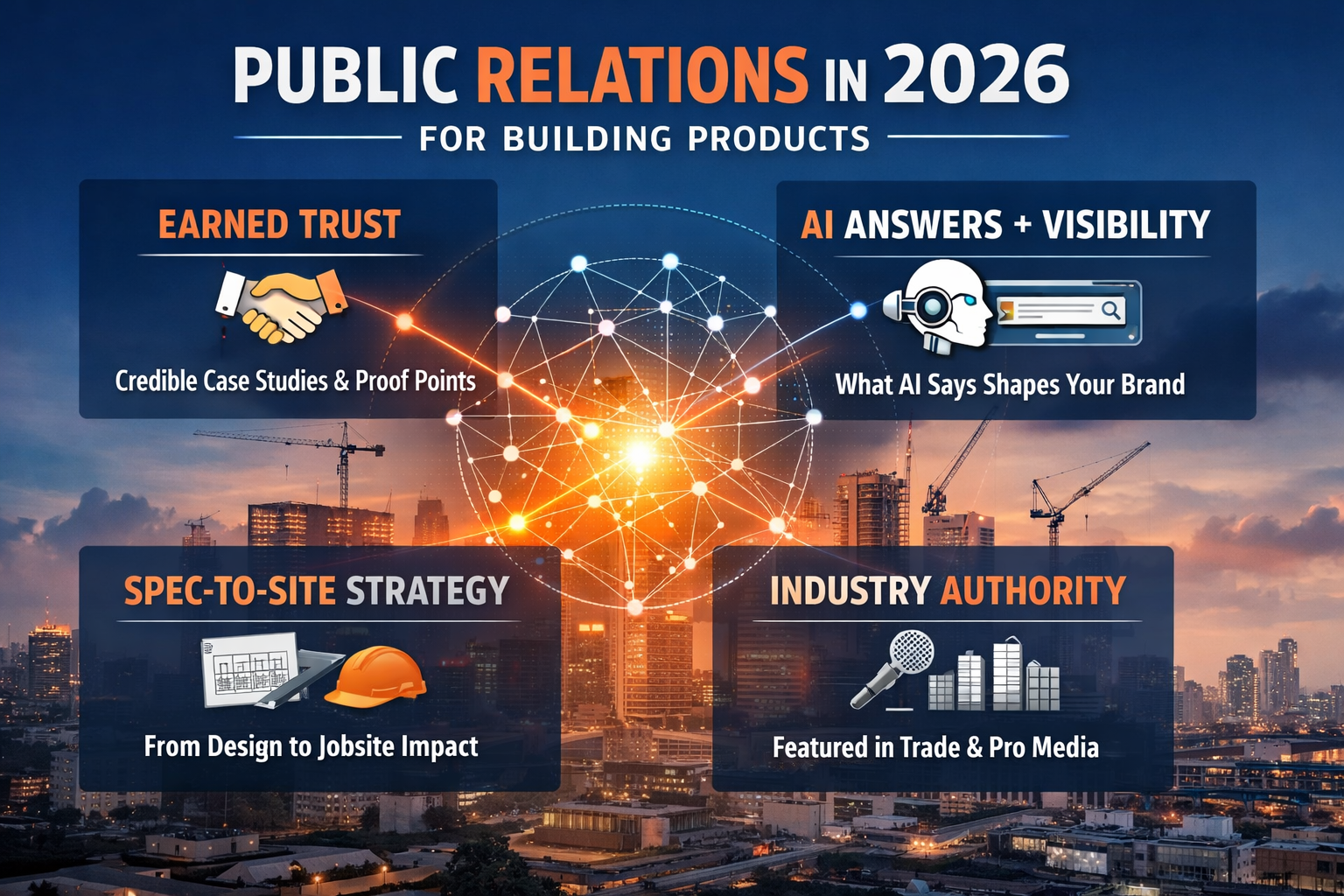
If you make building products, 2026 is the year you stop thinking of PR as press releases and start treating it like a revenue-protecting system.
Why? Because your reputation and discoverability are increasingly shaped by what AI tools say about you, not what your website claims about you. At the same time, the media ecosystem is shifting under everyone’s feet: publishers are bracing for meaningful traffic declines as AI summaries and chat interfaces intercept the click.
What this really means is simple: the brands that win will be the ones with credible, consistent third-party validation, distributed in the places architects, builders, contractors, designers, and remodelers actually pay attention to.
Below are the trends to prepare for in 2026, and exactly how to apply them to building products manufacturers.
1) Generative Engine Optimization is now a PR job, not an SEO side quest
In 2026, “search” is increasingly becoming “answers.” PRDaily’s 2026 trend coverage puts it plainly: brand reputation will be shaped by AI answers, and that elevates earned media, authoritative content, and consistent messaging from nice-to-have to existential.
This aligns with the broader media reality: publishers expect AI summaries/chatbots to reduce the traditional traffic they used to live on. If fewer people click through to your site, then your product pages can be perfect and still not matter as much as the ecosystem of credible references about you.
How building products brands should respond
-
Build an “AI-citable” footprint. Prioritize trade outlets, credible local business media, association publications, and technical partners where coverage tends to be referenced and repeated.
-
Stop shipping inconsistent specs and claims into the wild. If your sustainability story differs between your submittal sheet, your website, and your sales deck, AI will confidently remix the mess.
-
Create a citation ladder:
-
authoritative third-party coverage,
-
independently verifiable data (EPDs, testing, code reports),
-
customer proof (case studies with named firms),
-
expert voices (engineers, building scientists, credible installers).
-
Deliverable to put on your 2026 PR roadmap: a quarterly “Authority Coverage Plan” that maps priority topics (fire, moisture, acoustics, IAQ, embodied carbon, labor savings, lifecycle cost) to target publications and proof points.
2) Trust is the scarce resource, and “AI slop” makes it scarcer
The Reuters Institute’s 2026 predictions call out what many leaders are feeling: trusted, high-quality, accurate content becomes more valuable in a world flooded with low-quality and synthetic content.
So yes, you can publish 200 posts. But if your content feels generic, your buyers will treat it like packing peanuts: abundant, lightweight, and quickly discarded.
How building products brands should respond
-
Shift from “content” to “evidence.” Architects and builders don’t want more inspiration. They want fewer surprises. Lead with what reduces risk: performance, compliance, install clarity, warranty logic, and known-good details.
-
Put real names on real work. Anonymous case studies are marketing comfort food. Named projects with named partners are trust.
-
Use PR to validate what marketing claims. If you say “faster install,” PR shouldn’t repeat it. PR should prove it through a jobsite story, a builder quote, a documented labor delta, and photos that show the method.
3) The “traffic era” is fading. PR becomes distribution strategy, not just coverage
Media companies are already preparing for a world where fewer people arrive via traditional search, with AI summaries intercepting discovery.
If the old model was “get coverage → get clicks,” the 2026 model is “get coverage → get credibility → get repeated.”
How building products brands should respond
-
Design coverage to travel. Make every story modular: a trade article, a LinkedIn POV post from your technical lead, a short installer clip, and a spec-ready one-pager.
-
Invest in formats publishers are leaning into. Many outlets are pivoting harder into video platforms and creator-style distribution. Your PR plan should include video-ready story packages (b-roll, jobsite footage, spokesperson availability, stills, diagrams).
-
Treat LinkedIn as the press room for pros. Adoption and reliance on LinkedIn continues to rise among communicators, and many have reduced dependence on X as a professional channel. Your architect and builder audiences are already there. Act like it.
4) AI is everywhere in PR workflows… so governance and originality become differentiators
Cision’s reporting and PR industry coverage underscores rapid AI integration across PR activities. At the same time, industry commentary has flagged that a lot of firms are using AI without clear policies, which creates reputational and compliance risk.
In building products, where claims touch code, safety, and performance, sloppy use of AI can become expensive in a very unfun way.
How building products brands should respond
-
Create an AI usage policy for comms. Include claim substantiation, approval workflows, prohibited topics, and disclosure rules for imagery and testimonials.
-
Use AI to accelerate, not invent. Summarize standards. Draft outlines. Analyze coverage. But keep technical truth in human hands—engineering, product, legal, QA.
-
Originality wins. Your advantage isn’t “more posts.” It’s proprietary insight: testing data, field learnings, install methodology, service patterns, and the real-world consequences of failure.
5) Construction is evolving fast. PR must translate change into confidence
Industry outlooks for 2026 highlight continued focus on innovation, digital transformation, and navigating shifting market conditions in engineering and construction. Construction trend coverage also emphasizes technology adoption and changing workflows across the jobsite.
For building products brands, that creates a major PR opportunity: be the translator that turns complexity into decision-ready clarity.
How building products brands should respond
-
Own one “risk category” per quarter. Example themes:
-
Moisture and enclosure resilience
-
Fire performance and compliance pathways
-
Labor availability and install simplification
-
Embodied carbon and procurement pressure
-
Acoustics and occupant expectations
-
-
Build spokespeople beyond the CEO. Your most credible voices may be the building scientist, the technical services lead, the product manager, and the installer-trainer. Put them on the record.
-
Make your PR spec-useful. If architects can’t pull a detail, a compliance note, or a performance proof from your story, you wrote an essay, not a market asset.
6) Measurement gets sharper: PR has to show impact without pretending it’s paid search
The pressure to prove ROI isn’t new, but the environment is making it unavoidable. As PR budgets compete with performance marketing, you’ll need cleaner instrumentation and better definitions of success. Industry trend coverage emphasizes evolving tools and reporting sophistication in PR and comms.
How building products brands should respond
-
Use a measurement stack that matches your buying journey. Track:
-
Share of voice in your categories (by audience and outlet type)
-
Authority placements (top-tier trades, association channels)
-
Message pull-through (did the article include your proof points?)
-
Sales enablement outputs (case studies, one-pagers, spec downloads)
-
Down-funnel proxies (demo requests from target geos, rep inquiries after coverage, spec-in conversations)
-
-
Create “coverage-to-capability” reporting. Don’t just show logos. Show which coverage supports which sales motion: architect spec, builder conversion, contractor confidence, remodeler differentiation.
7) Community and credibility beat celebrity. Use “micro-authorities” who actually influence jobs
In 2026, influence in construction is often practical, not famous: the builder who teaches the best flashing method, the architect who publishes real details, the remodeler who documents jobsite surprises.
Publishers and brands are leaning more into creator-style distribution and partnerships. That doesn’t mean dancing on TikTok with a nail gun (unless that’s truly your brand). It means partnering with credible pros and building a repeatable program.
How building products brands should respond
-
Build a “Pro Council” program. A small group of respected architects, builders, and contractors who get early access, testing opportunities, factory tours, and a real feedback loop.
-
Pitch stories that feature the customer as hero. Media loves real-world problem solving. Your product becomes the enabling detail, not the main character who won’t stop talking about itself at dinner.
-
Turn field problems into editorial angles. “What failed, what we changed, and what it saved” is a better story than “we launched a new SKU.”
2026 PR Priorities Checklist for Building Products Manufacturers
If you do nothing else, do these:
-
Build an authority coverage plan designed for AI-citable credibility.
-
Tighten messaging and proof so trust is earned, not asserted.
-
Shift PR from “press” to “distribution system” as traffic patterns change.
-
Put AI governance in place so speed doesn’t outrun accuracy.
-
Translate construction change into confidence with practical, spec-useful storytelling.
-
Measure what matters: authority, message pull-through, and sales motion support.
-
Activate micro-authorities who influence real decisions on real projects.
A final, friendly warning: in 2026, the market will punish vague claims. The winners will look almost boring from the outside: consistent proof, consistent stories, consistent presence, in the right places, with the right partners. Boring is underrated when it ships on time and performs as specified.
About Draper DNA
Draper DNA is a marketing and communications consultancy that helps building products manufacturers earn attention, build credibility, and drive demand across the full ecosystem, including architects, builders, contractors, designers, and remodelers. We bring deep category fluency and practical experience translating technical performance into stories that land in the market.
How Draper DNA can help
Draper DNA develops and implements custom public relations programs built for how building products are actually specified, sold, and installed. Our work can include messaging and proof-point architecture, editorial and media relations strategy, earned story development, spokesperson training, thought leadership programs, project and partner case studies, PR measurement frameworks, and integrated distribution across trade media and professional social channels.
If you want a PR program that strengthens trust, improves visibility in an AI-shaped discovery world, and supports your sales motion from spec to site, Draper DNA can help. Reach out and we’ll map a practical plan around your category, channels, and growth goals.