Flooring Trends to Prepare for in 2026: What’s Changing, Why It Matters, and How Manufacturers Win
January 15, 2026
.
If you sell flooring in 2026 like it’s still 2022, you’re going to feel it in the margins, in the reviews, and in the showroom traffic. The category is evolving fast: consumers want fewer compromises, architects want proof, and dealers want product that installs clean, performs predictably, and doesn’t come with a chemical headache later.
Here are the trends that will shape flooring decisions in 2026 and what they mean for product manufacturers who want to grow share, not just “participate.”
1) Resilient keeps its crown, but the expectations get ruthless
Luxury vinyl plank/tile and rigid core are still the workhorses of the market, and 2026 doesn’t change that. What changes is the baseline: the “good enough” visuals and textures are getting weeded out.
What’s driving it
-
Printing, embossing, and surface texture are improving, making LVT/LVP more convincing as wood and stone stand-ins. Rejuvenation Floor & Design
-
Manufacturers are investing to expand domestic capacity in resilient (including SPC and LVT), which signals where demand is headed and helps reduce lead-time volatility. Floor Trends
What this means for manufacturers
-
Realism is table stakes. If your wood-look still looks like a screenshot from 2009, your competitor will happily take that order.
-
Performance claims get audited by homeowners. Waterproof, scratch resistance, dent resistance, and sound performance aren’t marketing lines anymore; they’re expectations. Miss them and your returns will remind you.
-
Domestic manufacturing becomes a strategic advantage. Faster replenishment and fewer surprises matter more in a slower-turn housing cycle.
How to prepare
-
Build a “proof stack” for every hero SKU: wear layer specs, acoustic underlayment recommendations, test standards, and real installation guidance. Make it easy for dealers and installers to trust you.
2) Warmth is winning: the “gray era” keeps fading
Design is continuing its pivot away from cool, flat grays and into warmer, natural tones. Consumers want rooms that feel lived-in, not lit like a laboratory.
You see it across the board: warm woods, honey/oak/toffee/walnut ranges, and lower-sheen finishes gaining preference, while high-gloss and overly cold palettes lose favor. The Spruce+1
What this means for manufacturers
-
Color and finish strategy becomes a product strategy, not a styling footnote.
-
Matte and low-sheen aren’t just “a look.” They also hide wear better, which makes customers feel like the floor is holding up.
How to prepare
-
Tighten your color line architecture: fewer redundant SKUs, stronger “warm neutral” coverage, and clearer naming that doesn’t require a decoder ring.
-
Create content that shows warm-toned floors in multiple lighting conditions. People don’t buy flooring under showroom LEDs. They buy it for their imperfect, yellowish kitchen lights.
3) Texture and tactile comfort move from “nice” to “necessary”
The market is leaning into surfaces that feel good, not just look good. That’s partly aesthetic and partly lifestyle: people want comfort at home, and commercial spaces want warmth without sacrificing cleanability.
Flooring publishers are explicitly calling out a return to tactile, comforting materials in color and design direction. Floor Covering Weekly
What this means for manufacturers
-
Texture isn’t just emboss depth; it’s how the floor supports a larger interior narrative: calm, grounded, durable.
-
In hard surfaces, that means smarter textures and better matte finishes. In soft surfaces, it means fiber stories, patterning that hides soil, and acoustic benefits that are easy to explain.
How to prepare
-
Refresh photography and product storytelling to emphasize feel: underfoot comfort, sound control, and “quiet luxury” visuals that don’t look sterile.
4) Pattern is back, but it’s getting more sophisticated
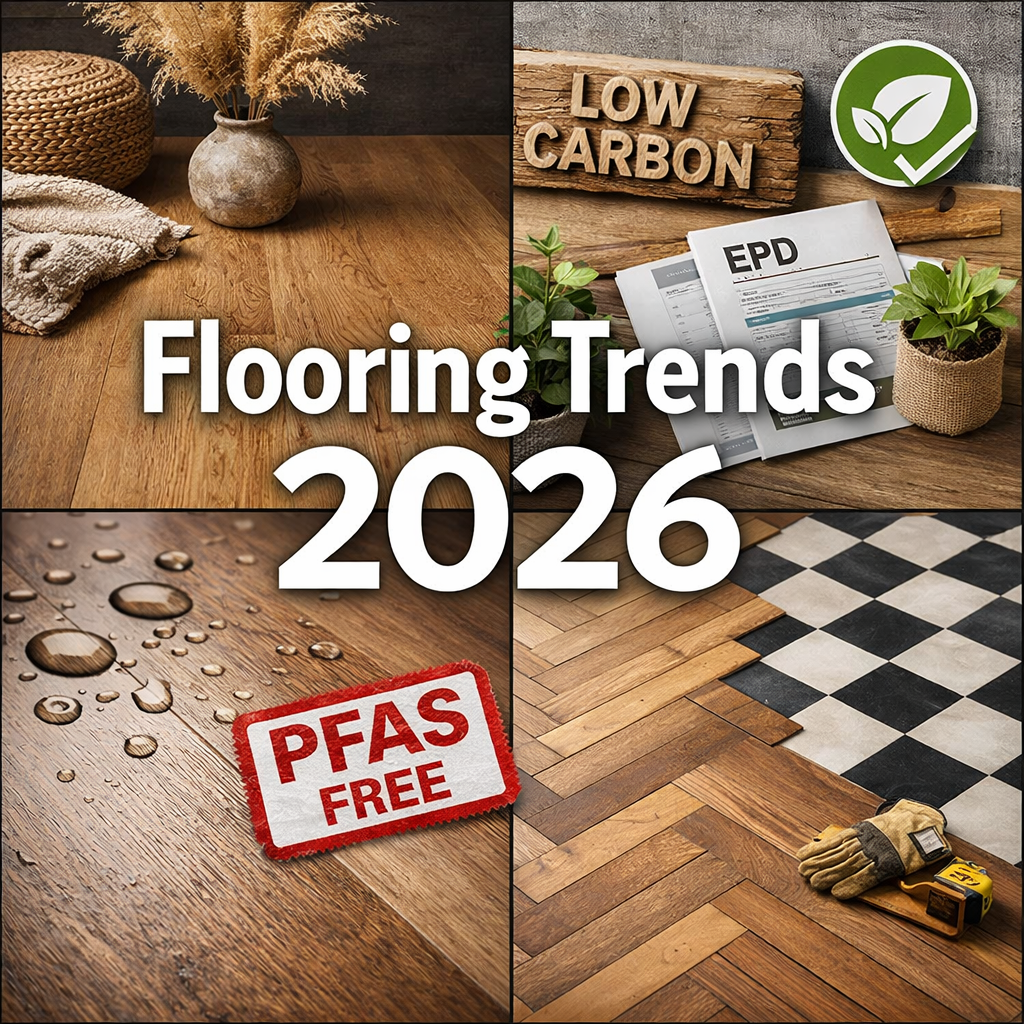
Wide planks and classic layouts aren’t going away. But 2026 is pushing harder into statement layouts: herringbone, chevron, parquet-inspired looks, and selective use of checkerboard (often in softer, updated colorways). Homes and Gardens+1
What this means for manufacturers
-
Pattern drives upsell when you package it correctly: trim, transitions, recommended installation diagrams, and curated bundles (floor + stair + accessory).
-
Retail salespeople love patterns because they’re easy to make aspirational. Installers love them when you’ve done the prep work and reduced guesswork.
How to prepare
-
Provide installer-ready resources: layout templates, waste-factor guidance, and transition details. If the only “guide” is a lifestyle photo, you’re leaving money on the table.
5) Material transparency and low-carbon stories are becoming the new sales language
Sustainability is no longer a vague “eco-friendly” badge. It’s increasingly about credible documentation, verified impacts, and circular pathways.
-
Industry guidance continues to emphasize the role of EPDs in transparent, comparable environmental performance. EPD International+1
-
The commercial side is pushing hard on take-back and reclamation: Interface’s ReEntry program is a visible example of flooring reclamation infrastructure. interface.com
-
Material health recognition is rising, like Shaw’s EcoWorx Resilient receiving a material health innovation award connected to HPDC. Floor Covering News
-
Laminate’s trade group messaging is also leaning into recycled content, circular processes, and resource reduction as part of 2026 direction. eplf.com
What this means for manufacturers
-
If you sell into A+D, corporate, education, healthcare, or public work, you need the documentation ready: EPDs, HPDs, VOC compliance, recycled content, end-of-life options.
-
Carbon and circularity stories need to be specific. Vague claims don’t survive procurement review.
How to prepare
-
Treat documentation like a product feature, not a compliance chore. Put it where specifiers actually look: product pages, spec downloads, BIM objects, and clearly labeled submittal packages.
-
Build a “sustainability narrative ladder”: what it is (simple), why it matters (impact), how it’s proven (docs), how it’s implemented (programs).
6) PFAS and chemical regulation pressure is real, and flooring is in the blast radius
Here’s the thing: chemical compliance isn’t just a carpet-and-upholstery issue anymore. PFAS restrictions are proliferating at the state level, and categories like carpets and rugs show up directly in multiple policy discussions. Business of Home+1
What this means for manufacturers
-
You need to know your full formulation and supply chain story, including additives, coatings, and treatments.
-
Retail and commercial customers will increasingly ask, “Is it PFAS-free?” even when they can’t define PFAS. Your answer still needs to be solid.
How to prepare
-
Get ahead of it: internal audits, supplier declarations, and a defensible public statement.
-
Train sales teams and dealer partners with a simple FAQ that doesn’t overpromise and doesn’t sound like legal wrote it after three espressos.
7) Radiant heat compatibility and “systems thinking” grow
Flooring selection is increasingly tied to the broader home performance conversation: comfort, energy, and smart systems. Even mainstream trend coverage is calling out integration with radiant heat and smarter home expectations, with engineered wood and tile often positioned as compatible choices. Rejuvenation Floor & Design
What this means for manufacturers
-
Performance is now about the system: subfloor prep, underlayment, moisture management, temperature swings, and acoustic performance.
How to prepare
-
Publish clear compatibility guidance (and don’t bury it in PDFs no one can find).
-
Offer accessory ecosystems or approved partner solutions (underlayments, moisture barriers, adhesives) so the outcome is predictable.
8) The market is uneven, so differentiation matters more than ever
Industry reporting has noted softness in consumer demand tied to broader housing and sentiment dynamics, with some category variation. Floor Covering Weekly That’s not a doom forecast. It’s a reminder: when demand is choppy, brand clarity and channel execution decide who grows.
What this means for manufacturers
-
You can’t rely on the category rising to lift your boat.
-
The winners will be the manufacturers who make it easier to choose them: clearer stories, cleaner merchandising, stronger dealer enablement, and better proof.
Where Draper DNA Fits: Turning Trends into Revenue, Not Just “Content”
Most manufacturers don’t struggle to see these trends. They struggle to convert them into:
-
the right product roadmap language
-
the right channel strategy
-
the right sales enablement
-
the right spec and retail storytelling
That’s the gap Draper DNA is built to close.
We help building-products manufacturers translate market shifts into practical action: positioning, messaging, dealer tools, specifier packages, content systems, and campaigns that move through the channel instead of dying in someone’s inbox. If 2026 is the year your category gets more competitive and more compliance-heavy at the same time, you don’t want generic marketing. You want marketing that understands what’s being installed, where it’s sold, and why people choose it.
And yes, we’ll still make it look good. We’re not monsters.
The 2026 “Do This Now” Checklist for Flooring Manufacturers
-
Upgrade your proof stack: performance, acoustics, moisture, wear, warranty clarity.
-
Align color + finish strategy to warm, natural palettes and lower sheen. The Spruce+1
-
Package pattern + layout as an upsell system with real installation support. Bud Polley’s Floor Center+1
-
Make sustainability documentation easy to find and easy to use (EPDs, HPDs, circular options). EPD International+2Floor Covering News+2
-
Get ahead of PFAS questions with supply chain clarity and customer-ready messaging. Business of Home+1
-
Think in systems: radiant heat compatibility, underlayment guidance, accessory ecosystems. Rejuvenation Floor & Design