Siding + Moisture Management in 2026: The Wall Is Getting Smarter (and Less Forgiving)
January 14, 2026
.
If you make siding, WRBs, sheathing, insulation, tapes, flashings, trim, or fasteners, 2026 is going to feel less like a “product year” and more like a “system year.” The market is done giving second chances to leaky walls. Owners, builders, and insurers are all quietly aligned on one thing: water belongs outside.
And here’s the thing. Moisture problems rarely come from one catastrophic mistake. They come from a dozen “pretty close” decisions that add up to rot, mold, callbacks, litigation, or the slow-motion budget death known as “envelope remediation.”
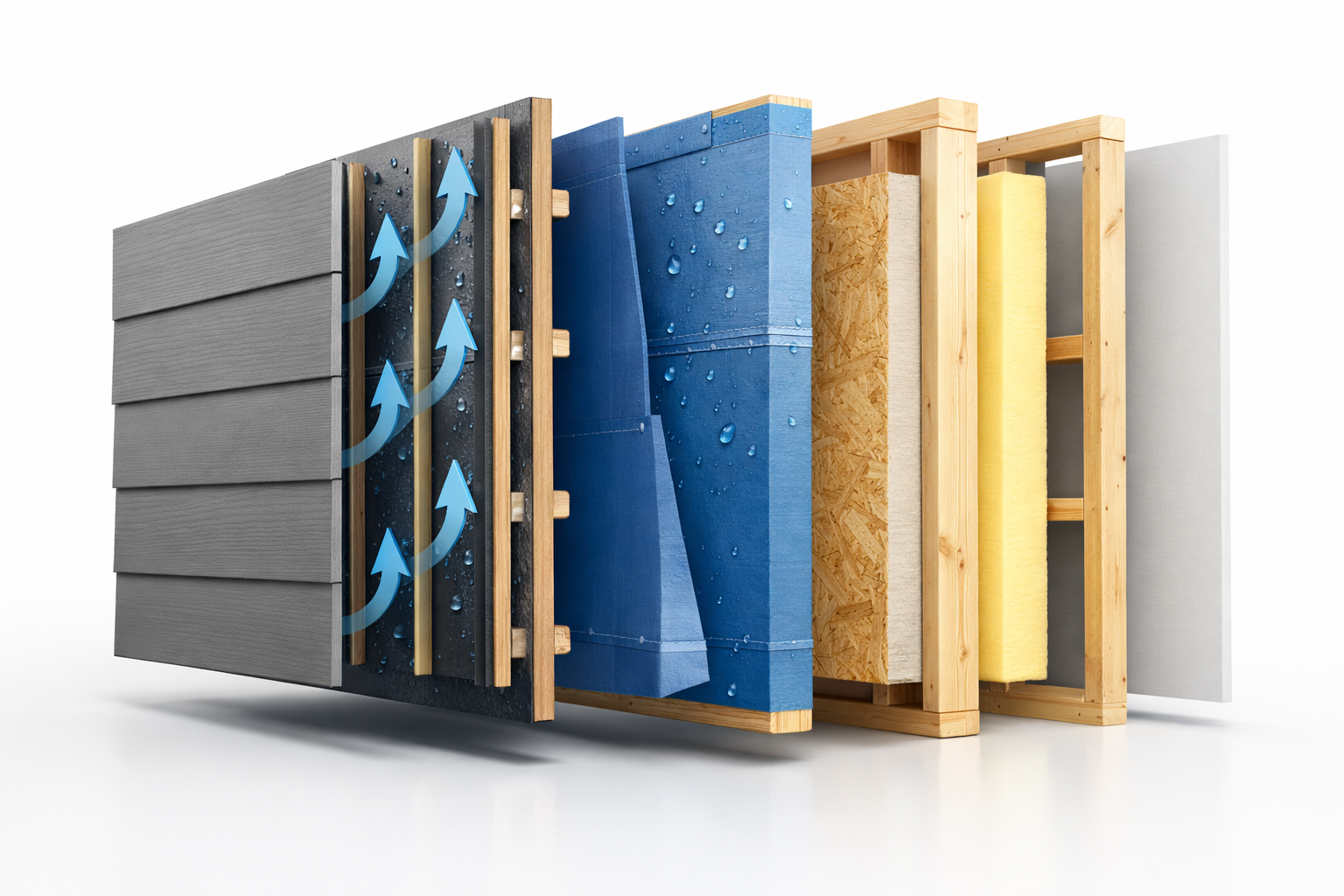
So let’s talk about the trends you should actually prepare for in 2026: what’s changing, why it’s changing, and how building-products manufacturers can win in a world where siding isn’t a skin, it’s a moisture-management strategy.
Trend 1: Rainscreens go from “nice to have” to “default”
For years, rainscreens were treated like the optional upgrade that only the building-science crowd ordered. That’s over. Codes have been moving toward requiring drainage/ventilation behind absorptive claddings, and industry guidance is getting louder because failures are too common and too expensive.
The 2021 IRC includes provisions that drive drainage behind certain claddings (including stucco details) and the industry is treating ventilated drying space as the safer baseline for assemblies that store and release moisture. ICC Digital Codes+1
What’s happening in practice in 2026:
-
More builders standardizing drained and ventilated cavities behind fiber cement, wood, engineered wood, and panel systems in mixed-humid and marine climates.
-
More architects and consultants specifying vented rainscreens (top + bottom ventilation) rather than just “drainable.”
-
More multifamily and light commercial projects insisting on tested, documented drainage mats/spacer systems instead of “we’ve always done furring.”
Manufacturer implications:
-
Stop marketing siding as a standalone product. Market your wall strategy: cladding + attachment + drainage + WRB compatibility + flashing details.
-
Provide assembly-level details by climate zone and exposure (coastal, wind-driven rain, high UV).
-
Document tested compatibility with common WRBs, tapes, and sealants. “Should work” is not a specification.
Trend 2: WRBs and air barriers converge into one expectation: continuous control layers
Moisture management is not just bulk water. Air leakage carries water vapor into cavities where it condenses on cold surfaces. That’s why the market is increasingly aligning around continuous control layers: water, air, vapor (managed, not “blocked”), and thermal.
Trade associations and technical resources keep reinforcing the WRB’s role as a required layer behind exterior veneers, along with integrated flashing to direct water outward. AWCI+1
What changes in 2026:
-
More projects specifying integrated air-and-water barrier performance, not just “housewrap included.”
-
More adoption of fluid-applied and self-adhered membranes in commercial and multifamily for continuity across transitions and penetrations (windows, balconies, ledger attachments).
-
More scrutiny on sequencing and trade coordination: the WRB isn’t “someone else’s problem” anymore.
Manufacturer implications:
-
If you manufacture cladding, publish clear rules for WRB type, drainage plane needs, fastener penetrations, and sealant compatibility.
-
If you manufacture WRBs/ABs, make it easier for crews to do it right: fewer steps, clearer details, better training assets, more forgiving transitions.
-
If you sell “systems,” prove it with documentation and third-party validation where possible.
Trend 3: Drainage performance gets quantified (and spec’d), not hand-waved
Specs are increasingly calling for measurable drainage capability, especially in high-risk walls. You’ll see more references to standardized testing and performance language around drainability and moisture management.
Industry articles and specifier guidance highlight performance testing and standards used to evaluate drainage and moisture management attributes of WRBs. Construction Specifier+1
Also, code and manufacturer guidance around stucco drainage details commonly reference minimum drainage spaces (often 3/16 inch) when certain WRB configurations are used. ICC Digital Codes+1
What changes in 2026:
-
More RFPs and submittals asking “What’s the drainage gap and how is it maintained?”
-
More focus on surfactant resistance, UV exposure limits, fastener sealing performance, and real jobsite durability (not just lab perfection).
-
More confusion in the market because not all “drainage tests” evaluate the same thing (EIFS vs. WRB drainability vs. cladding-specific behavior). Expect more education needs.
Manufacturer implications:
-
Clarify what your product actually does: drainage, drying, vapor control, air tightness, UV exposure windows.
-
Publish “jobsite reality” guidance: what happens when it’s stapled crooked, taped in dust, or left exposed longer than planned.
-
Create easy submittal language and assembly diagrams that match how specifiers write.
Trend 4: Hygrothermal modeling becomes mainstream for high-risk assemblies
Moisture is now being modeled, not guessed. Designers want to know if an assembly will dry, when it won’t, and what happens in edge cases (driving rain + high interior humidity + cold snap).
ASHRAE Standard 160 is explicitly about moisture-control design analysis, with criteria for predicting and mitigating moisture damage in envelopes based on climate, construction type, and operation. ASHRAE+1
Meanwhile, hygrothermal tools like WUFI keep evolving and positioning themselves as standard practice for moisture risk assessment in envelopes. ibp.fraunhofer.de+1
What changes in 2026:
-
More building-envelope consultants running hygrothermal checks on “new” wall stacks (especially those mixing continuous insulation, taped sheathing, and reservoir claddings).
-
More attention to inward vapor drive and solar vapor drive (especially with dark siding colors and absorptive claddings).
-
More scrutiny of “all-in-one” assemblies that look clean on paper but can trap moisture if misused in certain climates.
Manufacturer implications:
-
Build and publish hygrothermal-ready data: vapor permeance, water absorption behavior, drying potential assumptions, and recommended climate applications.
-
Provide modeled or validated “approved assemblies” that designers can specify with confidence.
-
If your product is climate-sensitive, say so plainly. You’ll gain trust by steering people away from the wrong installs.
Trend 5: Fire performance and wall compliance keep tightening around “combustible components”
As insulation and WRB technologies expand (and as exterior wall assemblies get more complex), compliance questions rise. In commercial and multifamily especially, exterior walls containing combustible components often trigger NFPA 285 considerations depending on construction type, height, and assembly details.
NFPA describes NFPA 285 as the exterior wall fire propagation test method for assemblies with combustible components, and there are dedicated resources to navigate code requirements around these wall types. NFPA+1
What changes in 2026:
-
More GC and architect teams pushing manufacturers for assembly-level compliance clarity.
-
More “system responsibility” conversations: if you change one layer (WRB, foam, cladding), the whole compliance picture may change.
-
More value placed on manufacturers who make compliance easier to specify and approve.
Manufacturer implications:
-
Treat fire and moisture as co-equal performance narratives. You can’t win one by losing the other.
-
Provide clear assembly documentation: “If you pair our cladding with X WRB and Y insulation in this wall type, here’s what applies.”
-
Support the spec community with fast turnaround on compliance questions. Speed is a feature.
Trend 6: Moisture management becomes a business model, not a detail
In 2026, the winners won’t just sell siding. They’ll sell fewer callbacks, fewer claims, and better reputations for everyone downstream.
Where this shows up:
-
Builders want simplified, repeatable wall packages that crews can execute consistently.
-
Dealers want fewer “mystery failures” that turn into finger-pointing.
-
Owners want durability and predictable maintenance.
-
Insurers and risk managers increasingly care about envelope performance because water losses are brutal.
What manufacturers should build now:
-
System kits and verified assemblies
Pair your siding with recommended WRBs, tapes, flashings, venting components, and fasteners. Make it spec-ready. -
Training that doesn’t insult anyone’s intelligence
Short videos, field guides, and clean details that match the real sequence on a jobsite. -
Color + moisture guidance (yes, really)
Dark colors drive higher surface temperatures, which can amplify drying in some cases and vapor drive in others. Designers need practical guardrails, not vibes. -
Warranty language that aligns with modern assemblies
If your warranty assumes 1998 wall behavior, it’s going to read like a fax cover sheet.
What this means for your 2026 marketing
Technical advantages don’t win by themselves. The market has to understand them, trust them, and feel confident specifying them.
That means your content can’t be “product brochure marketing.” It has to be:
-
Assembly-first storytelling (how it performs as a wall)
-
Risk-reduction messaging (why it prevents failures)
-
Climate-specific clarity (where it works, where it doesn’t)
-
Installer-friendly proof (details, sequencing, training)
Because the buyer isn’t just buying siding. They’re buying the confidence that the wall won’t become a biology experiment.
Where Draper DNA fits
Draper DNA helps building-products manufacturers translate building science into market leadership. Not by watering it down, but by making it usable: clearer specs, stronger positioning, and content that makes architects, builders, and dealers feel like you just made their jobs easier.
In practical terms, that can look like:
-
A 2026-ready moisture-management messaging platform for siding and envelope products
-
Spec-friendly content systems: details, submittals, install guides, and CPD-worthy education
-
Dealer and contractor enablement campaigns that reduce install errors and increase preference
-
Thought leadership that ties performance to outcomes: durability, IAQ, resilience, and lifecycle cost
If 2026 is the year the wall becomes a system, you want to be the manufacturer who sells the system with the clearest playbook.
And yes, the bar is rising. But that’s good news if you’re prepared. Leaky walls don’t win awards. They win lawsuits.