Sustainability in Construction: The 2026 Playbook Building Products Manufacturers Can’t Ignore
January 21, 2026
.
If 2024–2025 was the industry arguing about whether sustainability would reshape construction, 2026 is when the market shrugs and says, “Cool. Show me your documentation.”
Owners, cities, and procurement teams are moving from vibes to verification. The winners won’t be the companies with the best green adjectives. They’ll be the ones who can prove performance, carbon impact, and compliance faster than the next bidder.
Here are the sustainability trends that will matter most in 2026, what’s driving them, and what building products manufacturers should do now to stay ahead.
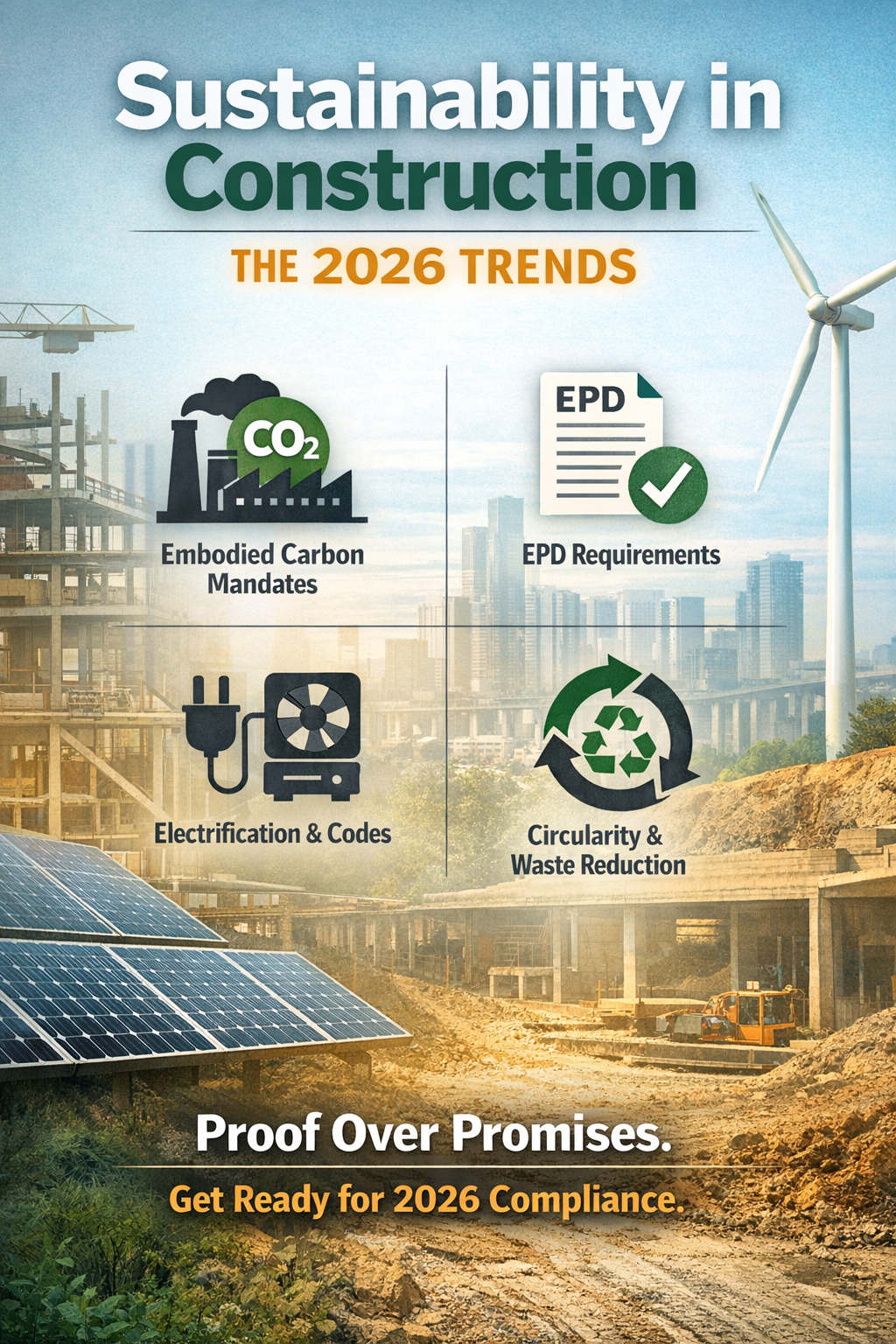
1) Embodied carbon goes from “nice-to-have” to “required to bid”
Operational energy still matters, but embodied carbon is the new knife fight. Governments and large buyers increasingly treat materials as climate policy.
A few signals that the shift is already here:
-
Federal procurement is pushing low-embodied-carbon (LEC) materials. The GSA has published IRA-related LEC requirements covering categories like concrete/cement/CMUs, asphalt, steel, and glass, and it’s clear that EPD-backed carbon reporting is central to qualifying. U.S. General Services Administration+2U.S. General Services Administration+2
-
The GAO notes the federal approach relies on Environmental Product Declarations (EPDs) and global warming potential (GWP) as a selection mechanism for “substantially lower” embodied emissions. GAO Files
-
Buy Clean momentum is real at the state level, with steel industry tracking showing multiple states having enacted laws and others considering them. American Institute of Steel Construction
-
California has already moved embodied carbon into code territory, a bellwether other jurisdictions watch closely. AIA California
What this really means: if you sell into commercial, institutional, infrastructure adjacent, or public sector channels, 2026 is going to feel like a paperwork upgrade and a product strategy reset at the same time.
Manufacturer moves for 2026
-
Build a “carbon ready” product portfolio: prioritize SKUs where your footprint can be meaningfully reduced (material substitutions, recycled content with integrity, lower energy manufacturing, regional sourcing).
-
Make your carbon data procurement friendly: EPDs, PCR alignment, and clear GWP figures by product and plant.
2) EPDs become table stakes, and “no EPD” starts to look like “no bid”
The market has been politely requesting EPDs for years. The tone is changing.
One industry study found EPDs influence purchasing decisions, but lack of manufacturer EPDs is cited as a major barrier to embodied-carbon reductions. One Click LCA That’s a polite way of saying: the project team can’t select what they can’t substantiate.
Also, it’s worth grounding the definition: an EPD is a Type III environmental declaration under ISO 14025, providing third-party verified life cycle information. EPD International
And for federal LEC pathways, EPA’s interim determination is explicit about prioritizing emissions in the production stage (while acknowledging future evolution to use/disposal stages). US EPA
Manufacturer moves for 2026
-
Treat EPD creation like a product launch, not a side quest:
-
pick high-volume/high-spec products first
-
standardize internal data collection (energy, inputs, transport, yield, waste)
-
align marketing, sales enablement, and spec tools around the EPD outputs
-
-
Don’t stop at “having an EPD.” Make it easy to use:
-
one page “specifier summary”
-
downloadable files where spec teams already work (your site is fine; ideally also where the spec ecosystem lives)
-
3) Codes and electrification keep tightening, and 2026 is a practical deadline
Sustainability is increasingly enforced through energy codes and electrification policies. Even when jurisdictions differ, directionally the market is moving toward higher efficiency, electric readiness, and heat pump forward building systems.
Example: California’s 2025 Energy Code takes effect for permits on or after January 1, 2026, expanding heat pump adoption and encouraging electric readiness. California Energy Commission
Meanwhile, regional code adoption activity continues around the 2024 IECC and ASHRAE 90.1-2022, with states reviewing or adopting newer models and layering in readiness provisions. Northeast Energy Efficiency Partnership+1
And city policy is accelerating: one analysis found that by 2026, 17 cities in its study will prohibit fossil fuel systems in new construction, alongside other grid-related requirements. JLL
Manufacturer moves for 2026
-
Product roadmaps should assume more electric buildings:
-
electric-ready accessories, panels, and control compatibility
-
enclosure products that support tighter performance targets
-
ventilation/IAQ performance that aligns with tighter envelopes
-
-
Update your spec positioning:
-
not “we’re sustainable,” but “here’s how we help you pass code, hit performance targets, and document it.”
-
4) Building performance standards push existing buildings into the spotlight
New construction is important, but the big carbon math lives in existing buildings.
Building performance standards (BPS) and carbon caps are forcing owners to retrofit and decarbonize, and those projects purchase a lot of building products.
New York City’s Local Law 97 is a high-profile example: emissions limits began in 2024, with stricter limits in 2030 and a long runway to net zero by 2050. NYC Government
Even if you don’t sell in NYC, policies like this influence investor expectations, portfolio strategies, and “standard practice” specs far outside city limits.
Manufacturer moves for 2026
-
Package retrofit-friendly offerings:
-
systems compatibility, fast install, and clear performance documentation
-
-
Help customers quantify outcomes:
-
simple calculators, retrofit playbooks, and before/after narratives backed by data
-
5) Green building programs evolve: LEED v5 raises the bar
Certifications aren’t the whole story, but they remain a major buyer signal and spec driver.
USGBC indicates the LEED v5 rating system is balloted/released on a 2025 cadence, moving to a predictable five year cycle. U.S. Green Building Council+1
Translation: the mainstream green building framework is being updated for a world where decarbonization and verified outcomes matter more than checklists.
Manufacturer moves for 2026
-
Map your product documentation to LEED v5-era expectations:
-
EPDs and low carbon pathways
-
health and material transparency where relevant
-
resilience and durability narratives that hold up under scrutiny
-
-
Enable your reps:
-
“Which credits does this help with?” needs a crisp, accurate answer
-
6) Circularity gets real because waste is too big to ignore
Construction and demolition waste is staggering. EPA estimates 600 million tons of C&D debris were generated in the U.S. (based on 2018 data), more than twice municipal solid waste. US EPA
That scale is why reuse, take back programs, and design-for-disassembly are shifting from idealistic to economically rational, especially as disposal costs rise and municipalities tighten rules.
Manufacturer moves for 2026
-
Identify one circular program you can credibly launch:
-
take-back for offcuts/tear-outs (where feasible)
-
recycled content loops with verified chain of custody
-
packaging reductions that don’t create a jobsite nightmare
-
-
Build circularity into product design:
-
modularity, repairability, replaceable components
-
documentation that makes salvage and reuse easier
-
7) Incentives are changing: plan for a moving target, not a forever tailwind
Incentives still matter, but the policy landscape is dynamic.
Example: DOE’s 179D page notes the One Big Beautiful Bill Act (Public Law 119-21, signed July 4, 2025) added a termination provision: 179D won’t apply to property where construction begins after June 30, 2026. The Department of Energy’s Energy.gov+1 The IRS also references this cutoff in its related guidance. IRS
Manufacturer moves for 2026
-
Don’t build your strategy on one credit.
-
Build a compliance + performance narrative that survives incentive swings:
-
code alignment
-
operating cost reduction
-
verified carbon and durability advantages
-
8) Greenwashing risk rises as claims get policed harder
As sustainability becomes procurement language, marketing claims become legal risk.
The FTC’s Green Guides remain a core reference point for environmental marketing claims, and the Guides are also listed among items under FTC review. Federal Trade Commission+1 Trade coverage notes updates have been awaited without a clear release timeline. Packaging Dive
Manufacturer moves for 2026
-
Audit your sustainability claims:
-
Can you prove it?
-
Can you prove it quickly?
-
Are you using precise language (and appropriate qualifiers) instead of broad “eco-friendly” fog?
-
-
Align legal, product, and marketing so your teams aren’t freelancing with climate claims.
The 2026 readiness checklist for building-products manufacturers
If you do nothing else, do these five things:
-
Publish EPDs for your highest-volume and most-specified products. One Click LCA+1
-
Prepare for low-embodied-carbon procurement requirements, especially public-sector-adjacent work. U.S. General Services Administration+1
-
Align product development with electrification and tighter codes (electric readiness, heat-pump-forward buildings). California Energy Commission+1
-
Package retrofit solutions for BPS-driven upgrades (because existing buildings are where budgets are piling up). NYC Government
-
Tighten sustainability marketing claims to stay credible and compliant. Federal Trade Commission+1
Where Draper DNA fits in
Most manufacturers don’t have a sustainability problem. They have a translation problem.
You can be doing real work, lowering emissions, improving health profiles, tightening performance, building better documentation and still lose deals because:
-
the spec team can’t find your proof fast enough
-
your sales team can’t explain it cleanly
-
your website buries the goods
-
your claims are either too timid to matter or too vague to trust
That’s where Draper DNA earns its keep. We help building-products manufacturers turn sustainability into market advantage by connecting four dots that are too often scattered across departments:
product reality → verified documentation → spec usability → buyer persuasion
In 2026, sustainability winners will look boring on the surface: solid data, clean documentation, clear claims, and products that help projects comply. Quietly lethal. (The best kind.)