Hardware Trends to Prepare For in 2026: The Small Parts Making the Biggest Moves
January 16, 2026
.
Hardware has always been the quiet overachiever of the built environment. It rarely gets a parade, but it’s the first thing you touch, the thing that keeps you safe, and the detail designers obsess over when the rest of the room is already “done.”
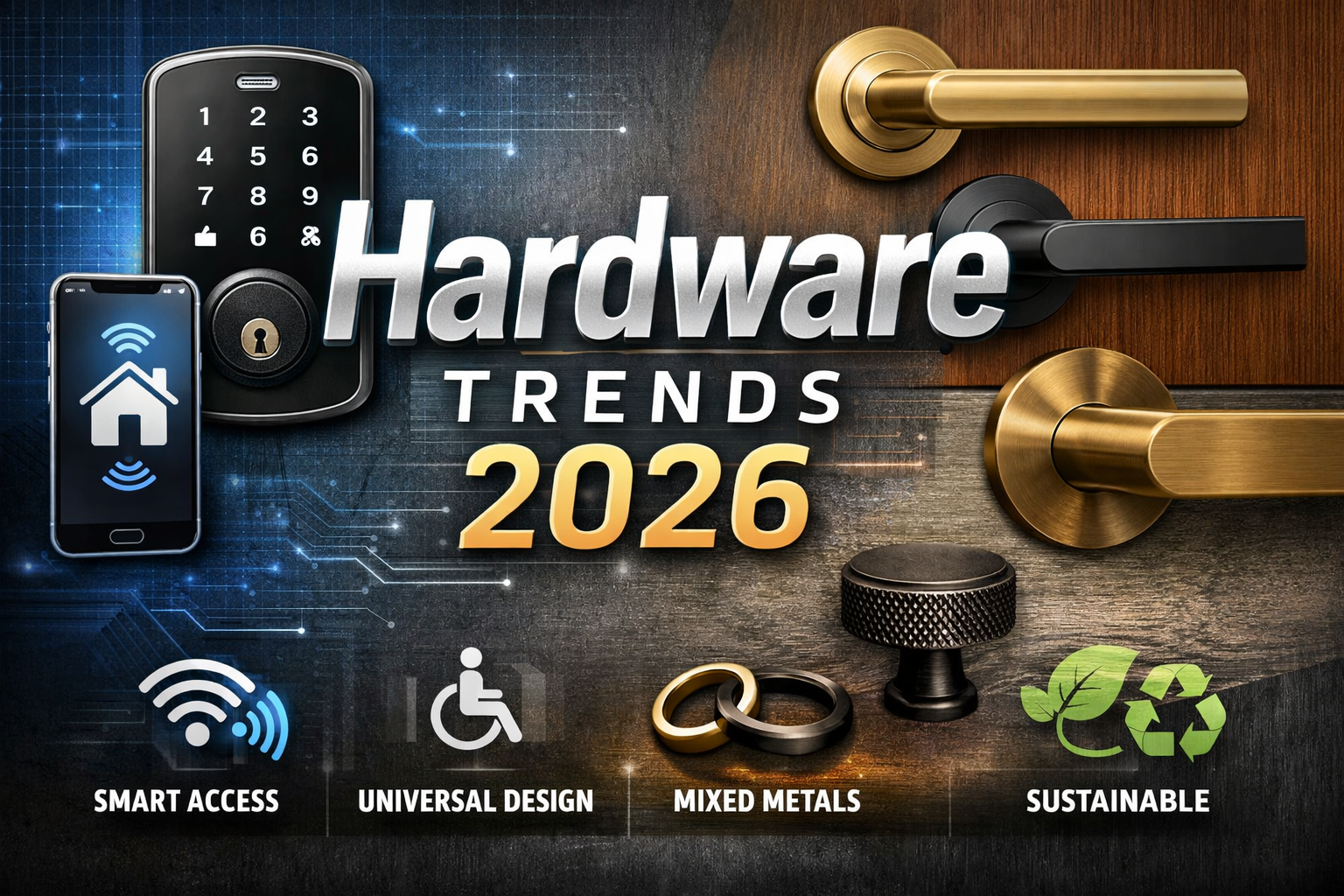
In 2026, hardware is moving from “finish selection” to “product ecosystem.” It’s becoming smarter, more interoperable, more tactile, more sustainable, and more regulated (in a good way). If you’re a manufacturer, this is a year to tighten product strategy, not just add another SKU in “champagne whatever.”
Here are the trends worth planning for and what they mean for building product manufacturers.
1) Interoperability becomes a buying requirement, not a nice-to-have
The smart home has spent years doing its favorite hobby: not getting along with itself. In 2026, that starts to change in a way consumers will actually notice.
Matter keeps pushing toward being the “common language” for smart devices. The Connectivity Standards Alliance positions Matter as an IP-based protocol intended to improve interoperability, reliability, and security across ecosystems. CSA-IOT+1
And importantly for manufacturers: major platforms have been moving toward recognizing Matter certification more broadly, which can reduce duplicated certification work and speed time-to-market. The Verge
Aliro is the next piece that matters specifically for access control: a standard designed to make mobile devices and wearables central to “digital access,” including definitions for NFC, Bluetooth LE, and UWB experiences, plus cryptography and credential data. CSA-IOT
What this really means is: in 2026, “works with everything” will start to beat “works with our app.”
Manufacturer implications
-
Product roadmap: If your portfolio includes connected locks, readers, or access control components, interoperability isn’t optional. Matter and Aliro alignment should be part of your near-term platform plan. CSA-IOT+1
-
Go-to-market: Train reps and distributors to sell outcomes: fewer apps, easier setup, fewer truck rolls. Matter’s ongoing focus on setup improvements (like NFC “tap-to-pair”) supports that story. The Verge
-
Partnership strategy: Aliro’s ecosystem is being shaped by major device and access players, and silicon providers are already signaling support. Qorvo+1
2) The “phone as key” era grows up: UWB, NFC, and hands-free entry
The 2026 user expectation: I should be able to unlock the door without performing a small ceremony.
We’re seeing three forces converge:
-
UWB (Ultra-Wideband) for precise proximity and intent detection
-
NFC for tap-to-unlock (fast, familiar)
-
Platform-friendly standards (Matter now, Aliro coming) that reduce brand lock-in
Coverage of new smart lock releases is already leaning hard into UWB and Matter compatibility as the feature stack people should care about. NAR+1
And the industry narrative is shifting toward open standards for digital keys across NFC, Bluetooth, and UWB, with Aliro positioned as the future glue. The Verge+1
Manufacturer implications
-
Design for “zero friction” onboarding. Consumers blame you when pairing is annoying, even if it’s technically someone else’s fault. Matter’s emphasis on better setup flows is a signal: onboarding is a product feature. The Verge
-
Think retrofit. Products that upgrade existing doors and hardware without a full rip-and-replace expand the addressable market dramatically (especially in remodeling).
-
Message security without sounding like a spy novel. Lead with convenience, then reassure with standards and testing.
3) Security and compliance: the boring stuff that wins bids (and avoids lawsuits)
As hardware gets smarter, expectations for proof get higher. In commercial and institutional segments especially, security isn’t vibes. It’s standards.
The ANSI/BHMA A156 series covers performance criteria across major builders hardware categories (locks, latches, closers, exit devices, etc.). Builders Hardware+1
For connected hardware, this matters because specifiers and facility teams increasingly want standardized performance signals, not marketing adjectives.
Manufacturer implications
-
Build spec-ready documentation. If the product is Grade 1, say so, document it, and make it easy to find.
-
Plan for “security meets IT.” Connected locks now live in the world of firmware updates, device identity, and ecosystem compatibility. Your warranty and support model needs to reflect that reality.
-
Make standards part of marketing. Not in a boring way. In a “this product won’t embarrass you in a submittal review” way.
4) Universal design isn’t a niche: it’s mainstream, measurable, and profitable
Aging-in-place and accessibility are reshaping what “good hardware” looks like. This shows up as bigger, easier-to-grip pulls, more forgiving ergonomics, and layouts that reduce dexterity demands.
Remodeling data reinforces that homeowners addressing age-related needs are choosing practical features, including wide drawer pulls, alongside other visibility and safety improvements. Houzz
And accessibility requirements for operable door hardware include mounting height guidance: operable portions typically fall in the 34–48 inch range in ADA guidance. Access Board+1
Manufacturer implications
-
Ergonomics is a differentiator. Comfort, grip geometry, return-to-door lever shapes, and tactile feedback aren’t “design details.” They’re usability.
-
Create an accessibility-forward line architecture. Make it easy for dealers, builders, and designers to specify compliant options without a scavenger hunt.
-
Sell to multiple audiences. The same wide pull can be “universal design,” “luxury convenience,” or “kid-proof practicality,” depending on channel and persona.
5) Mixed metals and warm finishes: the end of hardware monoculture
Design is loosening up. Uniformity is out; intentional layering is in. Mixed metals are being pitched as one of the easiest ways to add personality without remodeling the universe. Good Housekeeping
Manufacturers are also pushing the appeal of finishes that feel more “human”: warm metallics, softer bronzes, and surfaces that patina gracefully. Rocky Mountain Hardware, for example, highlights living finishes like bronze developing a patina over time on high-touch surfaces. Rocky Mountain Hardware
And the NKBA trend cycle for 2026 points to hardware spanning the spectrum from minimal bars to more ornate knobs as embellishment and expression. Business of Home
Manufacturer implications
-
Finish strategy needs discipline. Mixed metals doesn’t mean “make everything.” It means build coherent families that layer well together.
-
Content needs to show combinations. Don’t just photograph single SKUs on white backgrounds. Show finish pairings in real settings.
-
Plan for durability. The more tactile and visible the hardware, the less tolerance there is for finishes that wear poorly.
6) Tactility and “micro-statement” hardware: small scale, high impact
In 2026, hardware is increasingly treated like jewelry for the home: texture, knurling, engraved details, sculptural profiles, and oversized pulls that telegraph intention.
This trend rides alongside the broader “Modern Heritage” / character-forward design movement, where people want spaces that feel collected, not cloned. (Hardware is the cheapest way to make that happen without moving walls.)
Manufacturer implications
-
Invest in texture and grip. Tactile detail can be both aesthetic and functional. It’s one of the rare win-wins.
-
Offer smart customization. Limited-run textures, modular backplates, and configurable lengths can lift margins without exploding operations if you design the platform correctly.
7) Sustainability shows up in materials, coatings, and transparency
Sustainability is moving from “recycled content” headlines to deeper questions:
-
Where did the metal come from?
-
What’s in the coating?
-
How long will it last?
-
Can it be repaired or refinished?
Even in luxury segments, the story is shifting toward eco-conscious materials and non-toxic finishes, because buyers are connecting longevity with responsibility.
Manufacturer implications
-
Make durability part of sustainability. A handle that lasts 20 years is greener than one that needs replacing in five, even if the second one has a nicer press release.
-
Prepare for smarter spec questions. Commercial buyers will increasingly ask for documentation, not slogans.
Where Draper DNA fits: turning trends into revenue (not just content)
Knowing the trends is table stakes. Winning with them takes translation: product strategy to channel strategy to messaging to spec assets that actually get used.
This is where Draper DNA earns its keep. We help building product manufacturers:
-
prioritize which trends to chase (and which to ignore)
-
align product development with specifier and dealer realities
-
build content systems that drive demand without handcuffing your team
-
arm sales with simple, confident narratives backed by standards, proof points, and clear visuals
Put bluntly: 2026 will reward the manufacturers who make hardware easier to choose, easier to specify, easier to install, and easier to live with. The rest will compete on price and hope nobody notices.
The takeaway
Hardware in 2026 is a collision of design expression and system-level performance:
-
Mixed metals and warm finishes drive emotion. Good Housekeeping+1
-
Accessibility and ergonomics drive usability. Houzz+1
-
Standards like Matter and Aliro drive ecosystem trust. CSA-IOT+1
-
ANSI/BHMA benchmarks help you win specs and reduce risk. Builders Hardware
If you manufacture hardware, 2026 is not the year to treat “trend” as a finish board exercise. It’s a product architecture year. It’s a standards year. And yes, it’s also a “make it look and feel fantastic” year, because humans still have hands.