Construction Trends 2026: Why Experience Wins
January 12, 2026
.
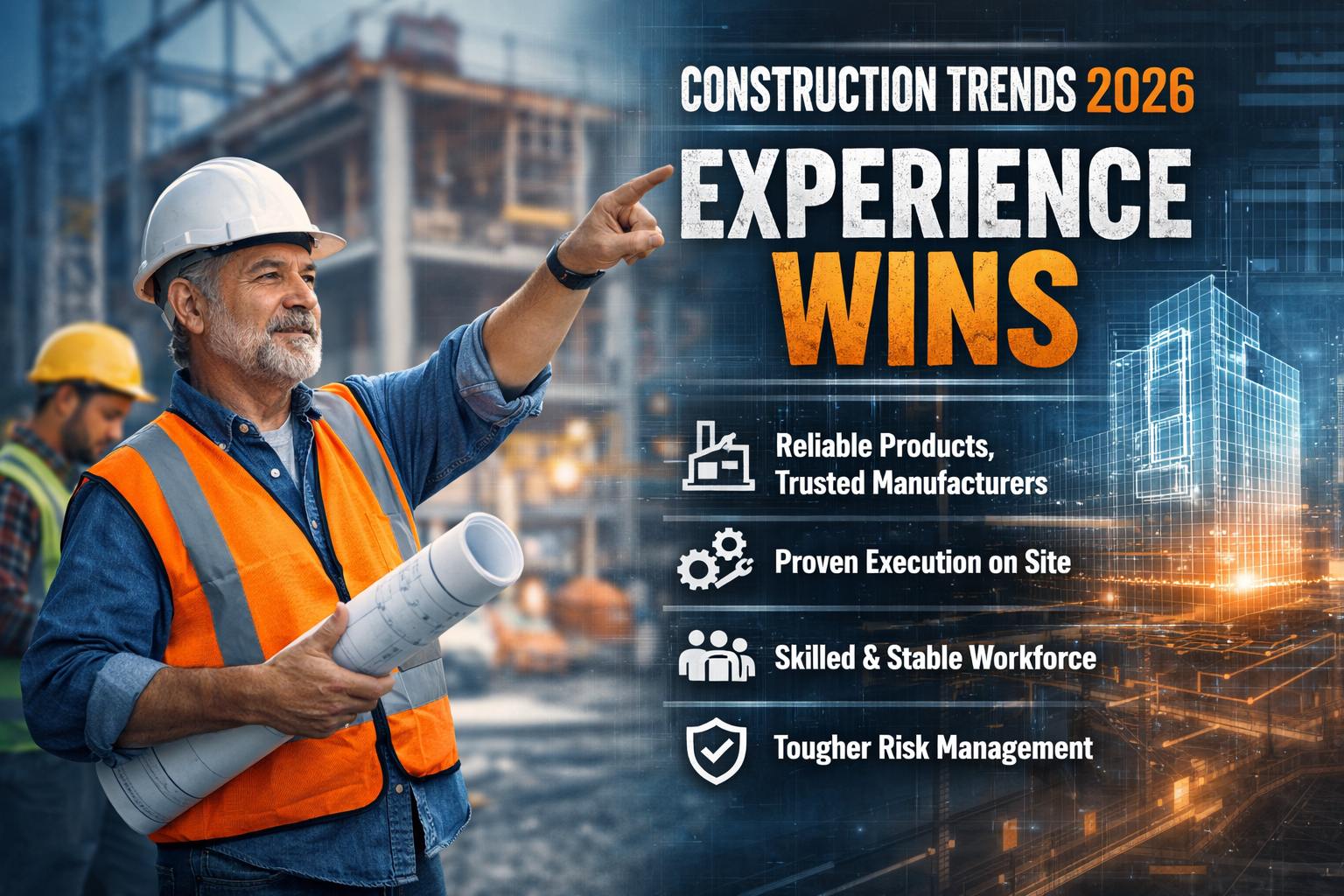
The Year Experience Stops Being Nice-to-Have and Becomes the Whole Game
Construction has always had a brutal scoreboard: did it get built, did it perform, and did it happen without lighting the budget on fire?
What’s changing heading into 2026 is how you get to “yes.” The industry is walking into a year where complexity rises, margins stay tight, and clients get pickier. The firms that win won’t be the ones with the flashiest tech demo or the loudest brand story. They’ll be the ones who can consistently deliver under pressure.
And that’s where experience matters.
Not as a vague credential. As a competitive advantage you can operationalize: better precon, fewer change orders, smarter sequencing, safer sites, tighter procurement, and crews that know how to solve problems before they become RFIs.
Let’s break down the trends you should be preparing for in 2026 and what they mean for anyone who builds for a living.
1) The market goes “two-speed”: big institutional work stays hot, while everything else fights for oxygen
If you build in the orbit of megaprojects, manufacturing, data centers, and major infrastructure, you’re likely to see sustained demand. If you’re primarily residential, light commercial, or discretionary capex, you’ll feel more price sensitivity and more scrutiny.
Industry outlooks are already signaling this split. Dodge forecasting coverage has emphasized data centers and megaprojects as major drivers even as broader starts soften. Engineering News-Record ConstructConnect similarly frames 2026 momentum around data centers and megaproject activity. ConstructConnect
Implication: You can’t run your business on “average market conditions.” You need a sector-specific strategy: which work you’re chasing, what risk profile you’ll accept, and how you’ll staff and self-perform around it.
Experience advantage: In choppy markets, owners reward reliability. Past performance, schedule credibility, and demonstrated risk control become a differentiator.
2) Residential improves—slowly—and “sales fixes” won’t beat “execution fixes”
Builder sentiment and forecasts have been pointing to modest improvement in 2026 (not a party, more like the lights come back on). NAHB has been signaling a slight gain in single-family starts after a down year, supported by easing rates and improving expectations. National Association of Home Builders+1
Implication: If you’re counting on a flood of easy projects, don’t. Customers will still be cautious. Financing will still matter. And whoever can deliver predictable schedules and reduce rework will look like a magician.
Experience advantage: The best “marketing” in a cautious housing cycle is operational excellence. Experienced teams tighten cycle time, reduce punch-list drag, and know where not to cut corners.
3) Materials pricing may look calm—until it doesn’t (tariffs and trade uncertainty are still in the room)
You can have stable pricing on paper and still get blindsided by reality: lead times, substitutions, and “that one package” that shows up 11% higher because the market moved.
Nationwide’s 2026 construction outlook highlights trade policy uncertainty and the risk of tariff-related increases showing up as inventories deplete. Nationwide Newsroom
Implication: Procurement becomes a strategy function, not a back-office task. Contract language, alternates, approved-equals, and early buy decisions will matter more.
Experience advantage: Veterans know where volatility usually hits first (MEP equipment, specialty metals, imported components) and how to structure buyout and schedules to reduce exposure.
4) Digital twins, AI, and BIM stop being “innovation” and start being baseline
By 2026, a growing share of owners and sophisticated GCs will treat modern data practices as table stakes. Deloitte’s engineering and construction outlook points to cloud-native digital twins and AI agents becoming standard as firms plan through 2026, alongside stronger data governance and workforce upskilling. Deloitte
This isn’t about buying shiny software. It’s about connecting design, field, and operations so decisions get made with evidence, not gut feel (or worse, the loudest voice in the trailer).
Implication: Expect more requirements around model-based coordination, reality capture, structured handover data, and operational outcomes. The “we’ll figure it out in the field” approach gets expensive fast.
Experience advantage: Here’s the twist: tech amplifies the best builders and exposes the sloppy ones. The firms with deep construction judgment will use AI and model workflows to prevent problems. The rest will use them to generate prettier reports about problems they still had.
5) Platform consolidation: fewer tools, more integration, and less patience for duct-tape workflows
The next step in construction tech is not more apps. It’s integrated platforms that connect BIM, scheduling, cost, sustainability reporting, and field execution.
This shift is being called out across AEC tech trend coverage for 2026, which emphasizes integration and scalable platforms over point solutions. Build in Digital
Implication: If your process depends on heroic PMs manually reconciling spreadsheets, photos, and emails, you’re paying a hidden tax every day. That tax gets bigger as projects get more complex.
Experience advantage: Experienced operators know what information actually matters. They’re the ones who can define workflows that people will follow under real jobsite stress.
6) Labor stays tight—so your training system becomes your growth system
The “find more people” strategy is not a strategy. It’s a wish.
The workforce challenge remains a consistent theme across construction outlooks, and even outside the U.S., major event-driven construction ramps are openly forecasting painful shortages. The Australian (Different market, same reality: demand spikes meet a limited pipeline.)
Implication: If you want capacity in 2026, you need a repeatable way to turn new hires into competent contributors fast. That means standardized work, clear quality checklists, mentoring, and leadership development for foremen and supers.
Experience advantage: Your best people can either be your advantage—or your bottleneck. The winning firms will extract their expertise into training, playbooks, and coaching instead of letting it live only in someone’s head.
7) Energy performance and “electrification readiness” keep moving from niche to normal
Whether the driver is regulation, incentives, owner preference, or operating cost reality, demand for energy-efficient and tech-forward features is rising. Even mainstream housing forecasting is pointing to stronger interest in energy-efficient and “tech-forward” features. Better Homes & Gardens
Implication: Expect more projects to require tighter envelopes, better detailing, higher-performing windows and doors, improved ventilation strategies, and electrical capacity upgrades. This raises the bar on coordination and sequencing, because building science punishes sloppiness.
Experience advantage: High-performance construction is unforgiving. The experienced teams who understand moisture management, air sealing continuity, and trade choreography will outperform teams who treat it like a product swap.
8) Risk management gets sharper: insurance, contracts, and “who owns the downside”
Owners, lenders, and insurers are increasingly intolerant of surprises. That means more contract scrutiny, more documentation, and more emphasis on safety and quality systems.
Implication: The bar rises for precon diligence, constructability reviews, and defensible decision-making. If your project controls are weak, you’ll feel it in claims, premiums, and disputes.
Experience advantage: Seasoned builders don’t just “build.” They manage risk before it becomes a cost code.