Home Office Design Trends to Prepare for in 2026
January 30, 2026
.
(Because your desk shouldn’t feel like a punishment.)
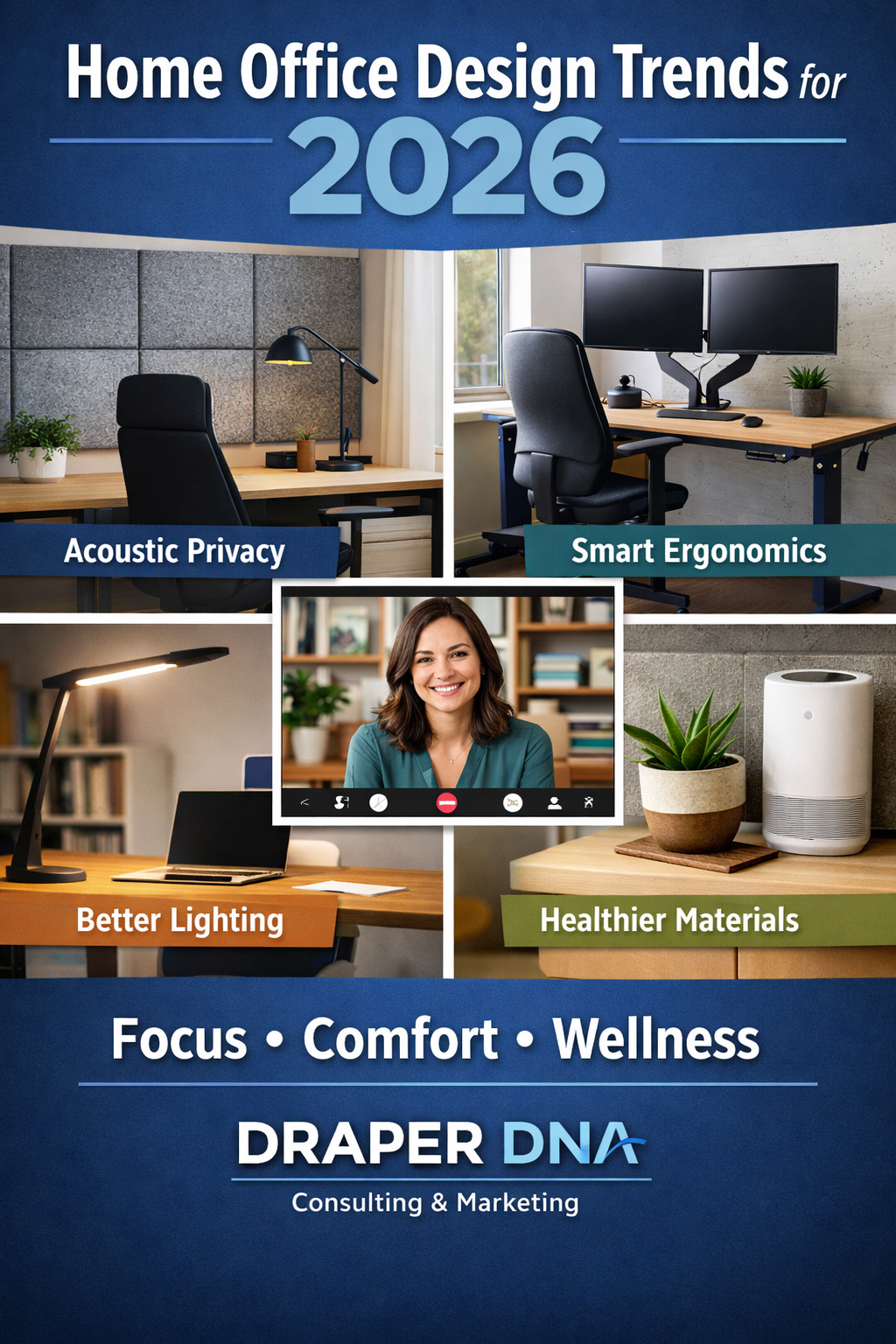
The home office is no longer a temporary setup held together by hope, a wobbly kitchen chair, and a laptop balanced on a shoebox. It’s become a permanent piece of the home, and in 2026 it’ll be treated like one: more intentional, more ergonomic, more tech-aware, and a lot more focused on how work actually happens (deep work, video calls, collaboration bursts, recovery time).
Here’s what’s changing, why it matters, and what product manufacturers should be building, messaging, and merchandising now.
1) Privacy becomes a feature, not a luxury
Hybrid work stabilized. The problem is the spaces didn’t keep up. Research and workplace design thinking are crystal clear: people need control over distraction, especially noise and visual interruptions. Framery’s Workplace Trends Report for 2026 calls out the mismatch between flexible policies and environments that still don’t enable focus, highlighting noise and interruptions as persistent barriers and noting rising expectations for enclosed, distraction-free spaces. Framery
Steelcase research has been hammering this same nail: privacy and focus are not “nice-to-haves” anymore. Their workplace privacy work points to the growing need for environments and design elements that protect focus without isolating people. Steelcase+1
What this means in the home office (2026 reality):
-
Homeowners will buy privacy the way they buy storage: intentionally, and with standards.
-
Visual privacy matters (camera framing, backgrounds), but acoustic privacy is the real battleground.
Product implications for manufacturers:
-
Acoustic products: decorative sound panels, upholstered wall systems, acoustic art, rug pads, ceiling baffles scaled for residential.
-
Furniture: high-backed lounge/task seating, wraparound desk screens, modular partitions that look like millwork.
-
Doors + hardware: interior doors marketed for sound control, not just style. (Solid-core becomes a selling point again.)
-
Messaging: sell “focus” like a performance spec, not a vibe. Use measurable language (sound absorption, NRC ratings, STC outcomes where relevant).
2) Ergonomics gets smarter and more personal
We’re past the era of “ergonomic = expensive chair.” In 2026, ergonomics is a system: chair + desk + monitor height + lighting + movement + temperature + acoustics. The modern workday is cognitively demanding, with more context switching as digital tools (including AI) embed deeper into daily routines. Framery’s report explicitly calls out intensifying cognitive demands and reduced recovery time. Framery
What changes in 2026:
-
Adjustable becomes expected.
-
Micro-movement (sit-stand, perching, leaning, shifting) becomes a design goal.
-
Ergonomics starts showing up in aesthetics: softer edges, warmer materials, more residential-friendly forms.
Product implications:
-
Desks: more sit-stand options that look like furniture, not office equipment. Cleaner cable management and quieter motors.
-
Seating: better adjustment with fewer “levers from NASA.” Make it intuitive.
-
Monitor + accessory ecosystems: arms, risers, under-desk support, footrests, task lighting sold as coordinated kits.
-
Retail strategy: bundle “workday performance sets” (desk + chair + light + acoustic + power).
3) Lighting shifts from “bright enough” to “biologically right”
Lighting isn’t decor anymore. It’s physiology. 2026 lighting trends lean toward layered lighting, sculptural fixtures, and tunable white that supports circadian rhythms. Veranda
What that means for home offices:
-
People want task lighting that reduces eye fatigue and looks good on camera.
-
Tunable, layered light becomes a productivity tool, not an upgrade.
Product implications:
-
Lighting manufacturers: design office-ready fixtures that don’t scream “corporate.” Think sculptural but purposeful.
-
Controls + smart lighting: simplify set-up. People want benefits without a 47-step app onboarding ritual.
-
Surface manufacturers (paint, wallcoverings, laminates): matte and low-sheen finishes reduce glare on camera and screens. Market that.
4) Backgrounds become brand assets (yes, even at home)
Video calls aren’t going away. The home office has become a stage set for professionalism, personality, and credibility. People will keep investing in what the camera sees.
2026 design cues:
-
Built-ins behind the desk (bookshelves, display niches, art lighting)
-
Purposeful material backdrops (wood slats, textured plaster, acoustic felt panels)
-
Better composition: symmetrical layouts, calmer palettes, fewer visual distractions
Product implications:
-
Casegoods + built-ins: modular systems designed for “camera wall” installs.
-
Wall systems: texture that reads well on video (not moiré patterns).
-
Lighting: picture lights, shelf lights, wall washers that make backgrounds look deliberate.
5) Wellness moves into the workspace: air, sound, touch
Home office design is absorbing the broader “wellness at home” movement. In workplace thinking, the physical environment is increasingly tied to mental well-being and the employee experience. Framery’s report cites external workplace research that underscores employee expectations around environment and well-being. Framery
And sustainability expectations keep tightening, including on materials chemistry. MillerKnoll made headlines for commitments around removing certain harmful chemicals (PFAS-free products in North America starting in 2025, per design-industry reporting). That’s the direction the market is heading: safer material stories told plainly. Architectural Digest
What shows up in home offices in 2026:
-
Better air quality expectations (low-VOC, filtration, humidity awareness)
-
Sound comfort (see Trend #1)
-
Tactile comfort: warmer materials, softer edges, “human” surfaces
Product implications:
-
Material suppliers: publish clear spec sheets and certifications people can understand.
-
Furniture + panel manufacturers: invest in healthier chemistry stories and make them marketable, not buried in PDFs.
-
Flooring: underfoot comfort matters when you’re pacing between calls.
6) Flexible layouts for homes that multitask
The home office is often not a dedicated room. It’s a guest room, a hallway niche, a loft corner, or the “we swear this is a dining room” space. In 2026, design adapts: fold-away, slide-away, hide-away, reconfigure.
What changes:
-
More compact footprints
-
More convertible furniture
-
More “it belongs in the home” styling
Product implications:
-
Murphy-style desks, wall-mounted workstations, compact sit-stand solutions
-
Storage that hides clutter fast (because nobody wants to start a Zoom call with a paper avalanche in frame)
-
Power: integrated outlets + USB-C where people actually work, not where building codes stopped in 2009.
7) The home office becomes a spec category
Here’s the strategic shift: home offices are becoming specified the way kitchens and baths are. That changes how manufacturers win.
In 2026, winning looks like:
-
Clear use-case segmentation (deep-focus office, creator studio, shared family office, micro-office)
-
Performance-forward marketing (acoustics, lighting quality, ergonomics, indoor air)
-
Cohesive systems, not one-off products
What product manufacturers should do now (to win 2026)
-
Build “focus” into product design: acoustic performance, privacy geometry, cable management, glare reduction.
-
Package solutions: sell complete office ecosystems. Consumers want confidence, not homework.
-
Create content that teaches: “How to set up a circadian-friendly office,” “How to reduce call noise,” “How to design a camera-ready background.”
-
Make specs understandable: translate performance metrics into outcomes people care about.
-
Merchandise by scenario: not by category. “Shared office,” “ADU office,” “small-space office,” “hybrid executive office.”
Where Draper DNA fits (and why it matters)
If you’re a building-products manufacturer, this category is a gift and a trap.
A gift because demand is real and durable: hybrid work is a baseline, and employees are still demanding environments that support focus, privacy, and well-being. Framery+1
A trap because the market is crowded with lookalike products and generic claims.
This is where Draper DNA earns its keep. We help manufacturers turn product truth into market preference by:
-
Mapping the full path from spec to shelf to install and back into advocacy
-
Building messaging that sells outcomes (focus, comfort, confidence), not features
-
Creating content and campaigns that educate buyers without boring them to death
-
Translating performance and sustainability into stories that people actually repeat
In other words: we don’t just make your home office product line “marketed.” We make it chosen.
The bottom line
Home offices in 2026 won’t be defined by trendy desk accessories. They’ll be defined by focus, privacy, lighting quality, healthier materials, and flexible layouts that respect how people work now.
And the brands that win won’t just follow design trends. They’ll package them into simple, credible solutions customers can buy with confidence.
If you’re a manufacturer looking at 2026 and thinking, “We have products for this, but we’re not showing up like it,” Draper DNA can help.
(Because the future of work isn’t going back to the office. It’s going wherever the Wi-Fi is strongest and the chair doesn’t ruin your spine.)